2023 Annual Survey of Nurses
Survey Data Tables
Analysis of the survey responses are presented in tables and charts below:
Survey Respondents & Response Rates
Demographic Characteristics of Survey Respondents, 2023
| Demographics | RN = 20,778 | LPN = 1,976 | ||
|---|---|---|---|---|
| n | Estimate | n | Estimate | |
| Age | ||||
| <25 years | 134 | 0.6% | * | * |
| 25 to 34 years | 1,521 | 7.3% | 103 | 5.2% |
| 35 to 44 years | 2,865 | 13.8% | 292 | 14.8% |
| 45 to 54 years | 3,613 | 17.4% | 355 | 18.0% |
| 55 to 64 years | 5,208 | 25.1% | 504 | 25.5% |
| 65 to 74 years | 4,688 | 22.6% | 443 | 22.4% |
| 75+ years | 753 | 3.6% | 47 | 2.4% |
| Unknown | 1,996 | 9.6% | 223 | 11.3% |
| Gender | ||||
| Female | 17,253 | 83.0% | 1,664 | 84.2% |
| Male | 1,637 | 7.9% | 91 | 4.6% |
| Gender non-binary/Genderqueer/Transgender | 34 | 0.2% | * | * |
| Prefer not to respond | 330 | 1.6% | 33 | 1.7% |
| Unknown | 1,524 | 7.3% | 185 | 9.4% |
| Race | ||||
| White | 17,444 | 84.0% | 1,375 | 69.6% |
| Black | 921 | 4.4% | 326 | 16.5% |
| American Indian | 247 | 1.2% | 44 | 2.2% |
| Asian/ Pacific Islander | 466 | 2.2% | 31 | 1.6% |
| Other | 452 | 2.2% | 72 | 3.6% |
| Unknown | 1,678 | 8.1% | 199 | 10.1% |
| Hispanic or Latinx | ||||
| Yes | 388 | 1.9% | 50 | 2.5% |
| No | 18,604 | 89.5% | 1,719 | 87.0% |
| Unknown | 1,786 | 8.6% | 207 | 10.5% |
| Middle Eastern | ||||
| Yes | 232 | 1.1% | 17 | 0.9% |
| No | 18,790 | 90.4% | 1,747 | 88.4% |
| Unknown | 1,756 | 8.5% | 212 | 10.7% |
| Region | ||||
| Upper Peninsula | 639 | 3.1% | 129 | 6.5% |
| Northwest LP | 834 | 4.0% | 63 | 3.2% |
| Northeast LP | 425 | 2.0% | 47 | 2.4% |
| West/West Central | 2,746 | 13.2% | 294 | 14.9% |
| East Central | 1,005 | 4.8% | 110 | 5.6% |
| East | 1,456 | 7.0% | 165 | 8.4% |
| South Central | 828 | 4.0% | 57 | 2.9% |
| Southwest | 1,223 | 5.9% | 124 | 6.3% |
| Southeast | 1,998 | 9.6% | 161 | 8.1% |
| Detroit Metro | 5,588 | 26.9% | 507 | 25.7% |
| MI, Unknown Region | 661 | 3.2% | 66 | 3.3% |
| Outside MI | 2,198 | 10.6% | 110 | 5.6% |
| Unknown | 1,177 | 5.7% | 143 | 7.2% |
a Gender options have been combined for the purpose of increasing the likelihood of having enough responses to be included in the analysis. Should the number be high enough, we will revisit separating out options in future surveys.
b Respondents were instructed to select all races that apply to them.
* Data are suppressed if count is less than 10 or sample population was less than 20.
Demographics of APNs who Completed National APN Certification & LARA-Certified APRNs and Nurse Anesthetists, 2023
| Demographics | Completed National APN Certification | LARA-Certified APRNs | |||
|---|---|---|---|---|---|
| N | Estimate | 95% CI | Estimate | 95% CI | |
| Total | 20,778 | 11.4% | (11.0%, 11.8%) | 89.5% | (88.2%, 90.7%) |
| Age | |||||
| <25 years | 134 | 0.0% | (0.0%, 2.8%) | 0.0% | (0.0%, 0.0%) |
| 25 to 34 years | 1,521 | 8.5% | (7.2%, 10.0%) | 93.8% | (88.0%, 96.9%) |
| 35 to 44 years | 2,865 | 15.8% | (14.5%, 17.2%) | 93.8% | (91.2%, 95.7%) |
| 45 to 54 years | 3,613 | 12.5% | (11.5%, 13.6%) | 92.5% | (89.7%, 94.6%) |
| 55 to 64 years | 5,208 | 9.6% | (8.8%, 10.4%) | 87.3% | (84.3%, 89.8%) |
| 65+ years | 5,441 | 11.0% | (10.2%, 11.9%) | 70.7% | (67.1%, 74.1%) |
| Gender | |||||
| Female | 17,253 | 11.0% | (10.5%, 11.5%) | 89.2% | (87.8%, 90.5%) |
| Male | 1,637 | 15.2% | (13.5%, 17.0%) | 91.3% | (87.2%, 94.2%) |
| Gender non-binary, Genderqueer, Transgender | 34 | 9.0% | (3.1%, 23.2%) | 100.0% | (43.8%, 100.0%) |
| Prefer not to respond | 330 | 13.2% | (10.0%, 17.3%) | 96.4% | (86.8%, 99.1%) |
| Race | |||||
| White | 17,444 | 11.2% | (10.7%, 11.7%) | 88.8% | (87.4%, 90.1%) |
| Black | 921 | 13.6% | (11.5%, 16.0%) | 86.4% | (79.3%, 91.3%) |
| American Indian | 247 | 12.8% | (9.2%, 17.5%) | 87.2% | (73.1%, 94.5%) |
| Asian/ Pacific Islander | 2,094 | 12.8% | (11.4%, 14.3%) | 87.2% | (76.4%, 93.5%) |
| Other Race | 452 | 13.9% | (11.0%, 17.4%) | 86.1% | (75.1%, 92.7%) |
| Hispanic or Latinx | |||||
| Yes | 388 | 8.8% | (6.4%, 12.0%) | 91.2% | (79.4%, 96.5%) |
| Middle Eastern | |||||
| Yes | 232 | 16.6% | (12.4%, 21.9%) | 83.4% | (69.1%, 91.9%) |
| Region of Residence | |||||
| Upper Peninsula | 639 | 10.4% | (8.3%, 13.0%) | 89.2% | (80.2%, 94.4%) |
| Northwest LP | 834 | 11.0% | (9.1%, 13.3%) | 88.2% | (80.9%, 93.0%) |
| Northeast LP | 425 | 11.4% | (8.7%, 14.8%) | 92.2% | (81.0%, 97.0%) |
| West/West Central | 2,746 | 7.8% | (6.9%, 8.9%) | 91.5% | (87.2%, 94.4%) |
| East Central | 1,005 | 11.3% | (9.5%, 13.4%) | 92.2% | (85.9%, 95.8%) |
| East | 1,456 | 10.1% | (8.7%, 11.8%) | 92.5% | (87.1%, 95.7%) |
| South Central | 828 | 11.0% | (9.0%, 13.3%) | 90.6% | (83.5%, 94.8%) |
| Southwest | 1,223 | 11.6% | (9.9%, 13.5%) | 91.1% | (85.6%, 94.6%) |
| Southeast | 1,998 | 12.3% | (10.9%, 13.8%) | 91.2% | (87.1%, 94.1%) |
| Detroit Metro | 5,588 | 13.8% | (12.9%, 14.7%) | 92.0% | (89.8%, 93.7%) |
| Unknown MI Region | 661 | 8.9% | (7.0%, 11.3%) | 91.2% | (81.7%, 96.0%) |
| Outside MI | 2,198 | 11.3% | (10.0%, 12.7%) | 72.8% | (67.0%, 77.9%) |
| Region of Employment | |||||
| Upper Peninsula | 489 | 11.5% | (9.0%, 14.6%) | 94.9% | (86.4%, 98.2%) |
| Northwest LP | 559 | 10.2% | (8.0%, 13.0%) | 93.2% | (85.0%, 97.1%) |
| Northeast LP | 265 | 13.7% | (10.1%, 18.4%) | 94.3% | (81.4%, 98.4%) |
| West/West Central | 1,911 | 8.1% | (7.0%, 9.4%) | 93.6% | (88.9%, 96.4%) |
| East Central | 794 | 14.3% | (12.0%, 16.9%) | 95.0% | (89.3%, 97.7%) |
| East | 910 | 13.6% | (11.5%, 16.0%) | 96.1% | (91.1%, 98.3%) |
| South Central | 636 | 12.0% | (9.7%, 14.8%) | 90.8% | (83.3%, 95.1%) |
| Southwest | 899 | 12.6% | (10.6%, 14.9%) | 96.6% | (91.7%, 98.6%) |
| Southeast | 1,735 | 13.6% | (12.1%, 15.3%) | 93.7% | (90.0%, 96.1%) |
| Detroit Metro | 4,029 | 14.0% | (13.0%, 15.1%) | 94.0% | (91.7%, 95.7%) |
| Unknown MI Region | 255 | 8.8% | (5.9%, 12.9%) | 73.9% | (53.0%, 87.6%) |
| Outside MI | 1,783 | 12.2% | (10.8%, 13.8%) | 75.0% | (69.0%, 80.2%) |
a Gender options have been combined for the purpose of increasing the likelihood of having enough responses to be included in the analysis. Should the number be high enough, we will revisit separating out options in future surveys.
b Respondents were instructed to select all races that apply to them.
Comparison of Survey Respondents to All Nurses Licensed in Michigan, 2023
| Characteristics | RNs | LPNs | ||||||
|---|---|---|---|---|---|---|---|---|
| Nurse Population | Survey Participants | Nurse Population | Survey Participants | |||||
| # | % | # | % | # | % | # | % | |
| Total | 173,419 | – | 20,778 | – | 20,324 | – | 1,976 | – |
| Age | ||||||||
| <25 years | 3,802 | 2.2% | 134 | 0.6% | 318 | 1.6% | * | * |
| 25 to 34 years | 36,307 | 20.9% | 1,521 | 7.3% | 3,355 | 16.5% | 103 | 5.2% |
| 35 to 44 years | 40,911 | 23.6% | 2,865 | 13.8% | 4,890 | 24.1% | 292 | 14.8% |
| 45 to 54 years | 36,285 | 20.9% | 3,613 | 17.4% | 4,628 | 22.8% | 355 | 18.0% |
| 55 to 64 years | 33,082 | 19.1% | 5,208 | 25.1% | 4,121 | 20.3% | 504 | 25.5% |
| 65 to 74 years | 20,007 | 11.5% | 4,688 | 22.6% | 2,619 | 12.9% | 443 | 22.4% |
| 75+ years | 2,986 | 1.7% | 753 | 3.6% | 385 | 1.9% | 47 | 2.4% |
| Unknown | 39 | 0.0% | 1,996 | 9.6% | * | * | 223 | 11.3% |
| Region | ||||||||
| Eastern/Central/ Western UP | 4,225 | 2.4% | 639 | 3.1% | 1,139 | 5.6% | 129 | 6.5% |
| Northwest LP | 5,073 | 2.9% | 834 | 4.0% | 456 | 2.2% | 63 | 3.2% |
| Northeast LP | 2,680 | 1.5% | 425 | 2.0% | 523 | 2.6% | 47 | 2.4% |
| West/West Central | 21,293 | 12.3% | 2,746 | 13.2% | 2,798 | 13.8% | 294 | 14.9% |
| East Central | 8,096 | 4.7% | 1,005 | 4.8% | 1,125 | 5.5% | 110 | 5.6% |
| East | 12,371 | 7.1% | 1,456 | 7.0% | 1,774 | 8.7% | 165 | 8.4% |
| South Central | 5,619 | 3.2% | 828 | 4.0% | 524 | 2.6% | 57 | 2.9% |
| Southwest | 9,756 | 5.6% | 1,223 | 5.9% | 1,245 | 6.1% | 124 | 6.3% |
| Southeast | 17,167 | 9.9% | 1,998 | 9.6% | 1,862 | 9.2% | 161 | 8.1% |
| Detroit Metro | 53,353 | 30.8% | 5,588 | 26.9% | 7,185 | 35.4% | 507 | 25.7% |
| MI, Unknown Region | 111 | 0.1% | 661 | 3.2% | 15 | 0.1% | 66 | 3.3% |
| Non-Michigan | 29,361 | 16.9% | 2,198 | 10.6% | 1,587 | 7.8% | 110 | 5.6% |
| Unknown Region | 4,314 | 2.5% | 1,177 | 5.7% | 91 | 0.4% | 143 | 7.2% |
| LARA-certified APRN (Advanced Practitioner Registered Nurse) | ||||||||
| Nurse Practitioner | 13,904 | 8.0% | 1,543 | 7.4% | – | – | – | – |
| Anesthetist | 3,099 | 1.8% | 321 | 1.5% | – | – | – | – |
| Midwife | 544 | 0.3% | 84 | 0.4% | – | – | – | – |
| Clinical Specialist | 310 | 0.2% | 167 | 0.8% | – | – | – | – |
* Data are suppressed if count is less than 10 or sample population was less than 20.
– Data are not available/data are not applicable.
Education
Educational Background that Qualified for First Nursing License among RNs: 2017, 2019, 2021, & 2023
| Education Level | 2017 | 2019 | 2021 | 2023 | ||||
|---|---|---|---|---|---|---|---|---|
| RN = 33,104 | RN = 15,865 | RN = 33,926 | RN = 20,757 | |||||
| Estimate | 95% CI | Estimate | 95% CI | Estimate | 95% CI | Estimate | 95% CI | |
| LPN diploma/certificate | 10.0% | (9.7%, 10.4%) | 4.2% | (3.9%, 4.5%) | 5.4% | (5.2%, 5.6%) | 5.7% | (5.4%, 6.0%) |
| RN diploma in nursing | 13.1% | (12.7%, 13.5%) | 8.7% | (8.3%, 9.1%) | 8.4% | (8.1%, 8.7%) | 7.3% | (7.0%, 7.7%) |
| Associate degree in nursing | 40.3% | (39.7%, 40.8%) | 36.1% | (35.4%, 36.9%) | 38.0% | (37.5%, 38.5%) | 35.4% | (34.8%, 36.1%) |
| Bachelor’s degree in nursing | 34.7% | (34.1%, 35.2%) | 44.4% | (43.6%, 45.2%) | 44.5% | (44.0%, 45.0%) | 47.1% | (46.4%, 47.8%) |
| Master’s degree in nursing | 1.8% | (1.6%, 1.9%) | 5.8% | (5.4%, 6.2%) | 3.7% | (3.5%, 3.9%) | 4.6% | (4.3%, 4.9%) |
Highest Level of Nursing-Related Education: 2017, 2019, 2021, & 2023
| Education Level | 2017 | 2019 | 2021 | 2023 | ||||
|---|---|---|---|---|---|---|---|---|
| RN = 33,007 | RN = 15,865 | RN = 33,792 | RN = 20,685 | |||||
| Estimate | 95% CI | Estimate | 95% CI | Estimate | 95% CI | Estimate | 95% CI | |
| LPN diploma/certificate | 0.0% | (0.0%, 0.0%) | * | * | * | * | * | * |
| RN diploma in nursing | 8.9% | (8.6%, 9.2%) | 6.7% | (6.3%, 7.0%) | 5.3% | (5.1%, 5.5%) | 4.3% | (4.0%, 4.6%) |
| Associate degree in nursing | 38.2% | (37.7%, 38.7%) | 32.0% | (31.3%, 32.8%) | 30.9% | (30.4%, 31.4%) | 26.5% | (25.9%, 27.1%) |
| Bachelor’s degree in nursing | 40.9% | (40.4%, 41.5%) | 46.0% | (45.2%, 46.8%) | 48.6% | (48.1%, 49.1%) | 50.9% | (50.2%, 51.6%) |
| Master’s degree in nursing | 10.9% | (10.5%, 11.2%) | 13.1% | (12.5%, 13.6%) | 13.1% | (12.7%, 13.5%) | 15.2% | (14.7%, 15.7%) |
| Doctorate in Nursing Practice (DNP) | 0.6% | (0.5%, 0.7%) | 1.4% | (1.2%, 1.6%) | 1.4% | (1.3%, 1.5%) | 2.2% | (2.0%, 2.4%) |
| Doctor of Nurse Anesthesia (DNAP) | – | – | 0.0% | (0.0%, 0.1%) | 0.1% | (0.1%, 0.1%) | 0.1% | (0.1%, 0.2%) |
| Doctor of Philosophy in Nursing (PhD) | 0.4% | (0.4%, 0.5%) | 0.8% | (0.6%, 0.9%) | 0.5% | (0.4%, 0.6%) | 0.7% | (0.6%, 0.8%) |
| Other doctoral degree in nursing | 0.1% | (0.1%, 0.1%) | 0.1% | (0.0%, 0.1%) | 0.1% | (0.1%, 0.1%) | 0.1% | (0.1%, 0.2%) |
| Education Level | 2017 | 2019 | 2021 | 2023 | ||||
| LPN = 5,743 | LPN = 1,812 | LPN = 4,276 | LPN = 1,969 | |||||
| Estimate | 95% CI | Estimate | 95% CI | Estimate | 95% CI | Estimate | 95% CI | |
| LPN diploma/certificate | 93.6% | (92.9%, 94.2%) | 94.2% | (93.0%, 95.1%) | 93.8% | (93.0%, 94.5%) | 94.1% | (93.0%, 95.1%) |
| RN diploma in nursing | 0.8% | (0.6%, 1.0%) | * | * | 0.5% | (0.3%, 0.8%) | * | * |
| Associate degree in nursing | 4.6% | (4.1%, 5.1%) | 5.0% | (4.1%, 6.1%) | 4.6% | (4.0%, 5.3%) | 4.2% | (3.4%, 5.2%) |
| Bachelor’s degree in nursing | 0.9% | (0.7%, 1.1%) | * | * | 0.9% | (0.7%, 1.2%) | 1.2% | (0.8%, 1.8%) |
| Master’s degree in nursing | * | * | * | * | * | * | * | * |
| Doctorate in Nursing Practice (DNP) | * | * | * | * | * | * | 0.0% | (0.0%, 0.0%) |
| Doctor of Nurse Anesthesia (DNAP) | – | – | * | * | * | * | 0.0% | (0.0%, 0.0%) |
| Doctor of Philosophy in Nursing (PhD) | * | * | * | * | 0.0% | (0.0%, 0.0%) | * | * |
| Other doctoral degree in nursing | * | * | * | * | * | * | 0.0% | (0.0%, 0.0%) |
* Data are suppressed if count is less than 10 or sample population was less than 20.
– Data were not available.
Highest Level of Non-Nursing Education: 2017, 2019, 2021, & 2023
| Education Level | 2017 | 2019 | 2021 | 2023 | ||||||||||||
|---|---|---|---|---|---|---|---|---|---|---|---|---|---|---|---|---|
| RN = 32,476 | LPN = 5,669 | RN = 15,381 | LPN = 1,795 | RN = 33,561 | LPN = 4,207 | RN = 20,435 | LPN = 1,912 | |||||||||
| Estimate | 95% CI | Estimate | 95% CI | Estimate | 95% CI | Estimate | 95% CI | Estimate | 95% CI | Estimate | 95% CI | Estimate | 95% CI | Estimate | 95% CI | |
| Non-nursing associate degree | 13.6% | (13.2%, 13.9%) | 22.8% | (21.7%, 23.9%) | 13.4% | (12.8%, 13.9%) | 24.3% | (22.4%, 26.3%) | 14.5% | (14.1%, 14.9%) | 25.0% | (23.7%, 26.3%) | 14.5% | (14.0%, 15.0%) | 24.9% | (23.0%, 26.9%) |
| Non-nursing bachelor’s degree | 13.9% | (13.5%, 14.2%) | 6.6% | (6.0%, 7.3%) | 15.9% | (15.4%, 16.5%) | 6.4% | (5.4%, 7.6%) | 15.9% | (15.5%, 16.3%) | 7.0% | (6.3%, 7.8%) | 16.0% | (15.5%, 16.5%) | 8.1% | (7.0%, 9.4%) |
| Non-nursing master’s degree | 5.2% | (5.0%, 5.5%) | 1.5% | (1.2%, 1.9%) | 6.8% | (6.5%, 7.2%) | 2.1% | (1.5%, 2.9%) | 5.7% | (5.5%, 6.0%) | 1.8% | (1.4%, 2.2%) | 5.9% | (5.6%, 6.2%) | 1.8% | (1.3%, 2.5%) |
| Non-nursing doctoral degree | 0.8% | (0.7%, 0.8%) | 0.3% | (0.2%, 0.5%) | 1.0% | (0.9%, 1.2%) | * | * | 0.7% | (0.6%, 0.8%) | 0.4% | (0.2%, 0.6%) | 0.6% | (0.5%, 0.7%) | * | * |
| Not applicable | 66.6% | (66.1%, 77.1%) | 68.8% | (67.6%, 70.0%) | 62.9% | (62.1%, 63.6%) | 66.8% | (64.6%, 68.9%) | 63.2% | (62.7%, 63.7%) | 65.8% | (64.4%, 67.2%) | 63.0% | (62.3%, 63.7%) | 65.0% | (62.8%, 67.1%) |
Nurses’ First Nursing Degree Compared to their Highest Nursing Degree: 2019, 2021, & 2023
| First Nursing Degree to Highest Nursing Degree | 2019 | 2021 | 2023 | ||||||
|---|---|---|---|---|---|---|---|---|---|
| n | Estimate | 95% CI | n | Estimate | 95% CI | n | Estimate | 95% CI | |
| LPN Diploma/Certificate as First Nursing Degree | |||||||||
| LPN diploma/certificate | 1,818 | 77.1% | (75.4%, 78.7%) | 4,284 | 72.7% | (71.6%, 73.8%) | 1,976 | 67.2% | (65.6%, 68.8%) |
| RN diploma/associate degree | 378 | 12.7% | (11.5%, 14.1%) | 1,027 | 14.4% | (13.6%, 15.3%) | 589 | 14.9% | (13.7%, 16.2%) |
| Bachelor’s degree in nursing | 216 | 7.3% | (6.3%, 8.4%) | 577 | 8.4% | (7.7%, 9.1%) | 456 | 12.3% | (11.2%, 13.5%) |
| Master’s or doctorate in nursing | 96 | 2.9% | (2.3%, 3.6%) | 345 | 4.5% | (4.0%, 5.0%) | 224 | 5.6% | (4.9%, 6.4%) |
| RN Diploma/Associate degree as First Nursing Degree | |||||||||
| RN diploma/associate degree | 5,602 | 77.2% | (75.5%, 78.8%) | 11,899 | 71.8% | (70.7%, 72.9%) | 6,765 | 65.8% | (64.1%, 67.4%) |
| Bachelor’s degree in nursing | 1,046 | 15.0% | (13.7%, 16.5%) | 3,115 | 19.7% | (18.7%, 20.7%) | 2,081 | 23.1% | (21.7%, 24.6%) |
| Master’s degree in nursing | 572 | 6.8% | (5.9%, 7.9%) | 1,322 | 7.3% | (6.7%, 8.0%) | 965 | 9.0% | (8.1%, 10.0%) |
| Doctorate in nursing | 87 | 0.9% | (0.6%, 1.4%) | 247 | 1.2% | (1.0%, 1.5%) | 232 | 2.0% | (1.6%, 2.5%) |
| Bachelor’s degree in nursing as First Nursing Degree | |||||||||
| Bachelor’s degree in nursing | 5,850 | 88.2% | (86.9%, 89.4%) | 11,541 | 85.1% | (84.2%, 86.0%) | 6,711 | 82.9% | (81.6%, 84.2%) |
| Master’s degree in nursing | 735 | 9.4% | (8.3%, 10.6%) | 1,910 | 12.4% | (11.6%, 13.2%) | 1,246 | 13.3% | (12.2%, 14.5%) |
| Doctorate in nursing | 189 | 2.4% | (1.9%, 3.1%) | 395 | 2.5% | (2.1%, 2.9%) | 339 | 3.8% | (3.2%, 4.5%) |
| Master’s Degree as First Nursing Degree | |||||||||
| Master’s degree in nursing | 924 | 88.2% | (86.9%, 89.4%) | 1,279 | 95.7% | (95.2%, 96.2%) | 946 | 92.6% | (91.6%, 93.5%) |
| Doctorate in nursing | 130 | 11.8% | (10.6%, 13.1%) | 66 | 4.3% | (3.8%, 4.8%) | 81 | 7.4% | (6.5%, 8.4%) |
a Associate degrees were included with RNs because many who start with an associate degree now have an RN degree as their highest level of education. Additionally, LPNs who did not answer the survey question about their highest level of education were categorized in the LPN diploma category. For this reason, sample size numbers may vary across tables.
b Doctorate degrees include PhD, DNP, DNAP, or other nursing doctorate degrees.
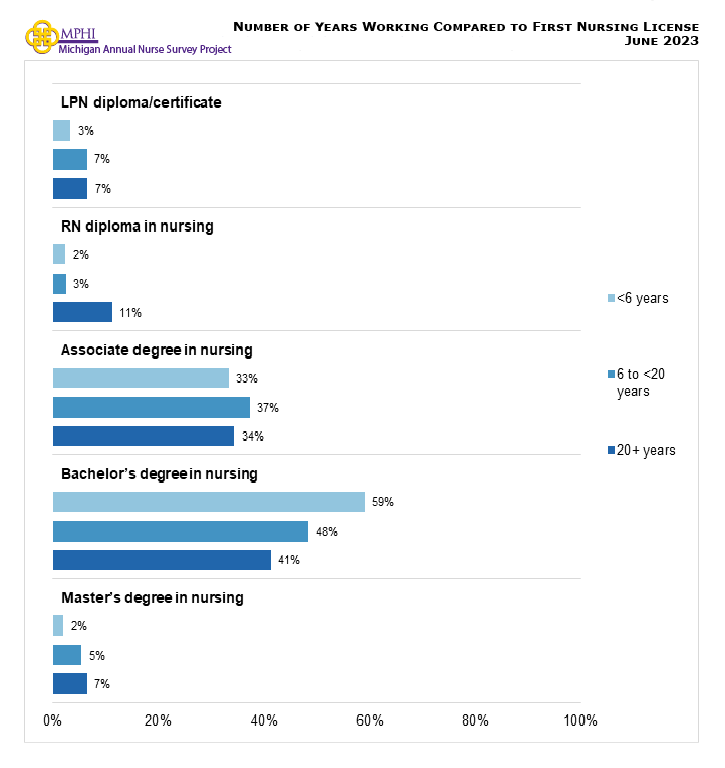
Number of Years Compared to the First Nursing License, 2023
Current Enrollment in Nursing Educational Programs, 2023
| Degree | RN= 1,064 | LPN= 194 | ||
|---|---|---|---|---|
| Estimate | 95% CI | Estimate | 95% CI | |
| Associate Degree in Nursing (ADN) | * | * | 81.0% | (74.9%, 85.9%) |
| Bachelor of Science in Nursing (BSN) | 40.6% | (37.7%, 43.6%) | 22.5% | (17.2%, 28.9%) |
| Master of Science in Nursing (MSN) | 40.7% | (37.8%, 43.7%) | * | * |
| Doctor of Nursing Practice (DNP) | 16.9% | (14.8%, 19.3%) | * | * |
| Doctor of Nurse Anesthesia (DNAP) | 3.0% | (2.1%, 4.2%) | 0.0% | (0.0%, 1.9%) |
| Doctor of Philosophy in Nursing (PhD) | 2.3% | (1.6%, 3.4%) | 0.0% | (0.0%, 1.9%) |
a Respondents were instructed to mark all that apply.
* Data are suppressed if count is less than 10 or sample population was less than 20.
Current Program Type, 2023
| Program Type | RN = 1,050 | LPN = 193 | ||
|---|---|---|---|---|
| Estimate | 95% CI | Estimate | 95% CI | |
| In-person | 8.9% | (7.3%, 10.8%) | 57.7% | (50.6%, 64.5%) |
| Online | 71.1% | (68.3%, 73.8%) | 12.2% | (8.3%, 17.6%) |
| Hybrid | 20.0% | (17.7%, 22.5%) | 30.0% | (24.0%, 36.8%) |
Current Enrollment in Educational Programs Associated with APN Nursing Specialty Certification Exams among all RNs, 2023
| Certification | RN = 18,312 | |
|---|---|---|
| Estimate | 95% CI | |
| Nurse Practitioner | 2.8% | (2.6%, 3.0%) |
| Nurse Midwife | 0.1% | (0.1%, 0.2%) |
| Nurse Anesthetist | 0.3% | (0.2%, 0.4%) |
| Clinical Nurse Specialist | 0.3% | (0.2%, 0.4%) |
Employment
Percentage of Nurses Who are Employed in Nursing by Demographic Characteristics, 2023
| Demographics | RN | LPN | ||||
|---|---|---|---|---|---|---|
| n | Estimate | 95% CI | n | Estimate | 95% CI | |
| Total | 20,778 | 80.4% | (79.9%, 80.9%) | 1,976 | 74.0% | (72.0%, 75.9%) |
| Age | ||||||
| <25 years | 134 | 95.5% | (90.5%, 97.9%) | * | * | * |
| 25 to 34 years | 1,521 | 90.5% | (88.9%, 91.9%) | 103 | 85.4% | (77.3%, 90.9%) |
| 35 to 44 years | 2,865 | 89.4% | (88.2%, 90.5%) | 292 | 83.9% | (79.2%, 87.7%) |
| 45 to 54 years | 3,613 | 90.1% | (89.1%, 91.0%) | 355 | 82.3% | (78.0%, 85.9%) |
| 55 to 64 years | 5,208 | 77.6% | (76.4%, 78.7%) | 504 | 69.4% | (65.2%, 73.3%) |
| 65+ years | 5,441 | 34.7% | (33.4%, 36.0%) | 490 | 37.1% | (32.9%, 41.5%) |
| Gender | ||||||
| Female | 17,253 | 80.0% | (79.4%, 80.6%) | 1,664 | 74.2% | (72.0%, 76.2%) |
| Male | 1,637 | 84.8% | (83.0%, 86.5%) | 91 | 70.2% | (60.1%, 78.6%) |
| Gender non-binary/ Genderqueer /Transgender | 34 | 88.1% | (73.2%, 95.2%) | * | * | * |
| Prefer not to respond | 330 | 77.3% | (72.5%, 81.5%) | 33 | 81.0% | (64.7%, 90.8%) |
| Race & Ethnicity | ||||||
| White | 17,444 | 79.9% | (79.3%, 80.5%) | 1,375 | 71.3% | (68.9%, 73.6%) |
| Black | 921 | 85.4% | (83.0%, 87.5%) | 326 | 82.1% | (77.6%, 85.9%) |
| American Indian or Alaska Native | 247 | 80.5% | (75.1%, 85.0%) | 44 | 76.4% | (62.1%, 86.5%) |
| Asian | 466 | 87.8% | (84.5%, 90.5%) | 31 | 83.6% | (67.1%, 92.7%) |
| Hispanic or Latinx | 388 | 89.9% | (86.5%, 92.5%) | 50 | 78.5% | (65.3%, 87.6%) |
| Middle Eastern | 232 | 78.2% | (72.5%, 83.0%) | 17 | 71.7% | (48.0%, 87.4%) |
| Other | 452 | 83.5% | (79.8%, 86.6%) | 72 | 73.2% | (62.0%, 82.1%) |
| Residence | ||||||
| Upper Peninsula | 639 | 80.4% | (77.1%, 83.3%) | 129 | 70.8% | (62.4%, 78.0%) |
| Northwest LP | 834 | 78.6% | (75.7%, 81.2%) | 63 | 73.3% | (61.3%, 82.7%) |
| Northeast LP | 425 | 77.2% | (73.0%, 80.9%) | 47 | 65.2% | (50.9%, 77.2%) |
| West/West Central | 2,746 | 80.7% | (79.2%, 82.1%) | 294 | 68.7% | (63.2%, 73.7%) |
| East Central | 1,005 | 82.6% | (80.1%, 84.8%) | 110 | 78.0% | (69.4%, 84.7%) |
| East | 1,456 | 81.8% | (79.7%, 83.7%) | 165 | 69.0% | (61.6%, 75.6%) |
| South Central | 828 | 82.7% | (80.0%, 85.1%) | 57 | 62.9% | (49.9%, 74.3%) |
| Southwest | 1,223 | 78.4% | (76.0%, 80.6%) | 124 | 71.5% | (63.0%, 78.7%) |
| Southeast | 1,998 | 79.9% | (78.1%, 81.6%) | 161 | 81.8% | (75.1%, 87.0%) |
| Detroit Metro | 5,588 | 80.2% | (79.1%, 81.2%) | 507 | 77.1% | (73.2%, 80.5%) |
| Unknown Michigan Residence | 661 | 87.6% | (84.9%, 89.9%) | 66 | 81.8% | (70.8%, 89.3%) |
| Non-Michigan Residence | 2,198 | 79.9% | (78.2%, 81.5%) | 110 | 77.8% | (69.2%, 84.6%) |
a Gender options have been combined for the purpose of increasing the likelihood of having enough responses to be included in the analysis. Should the number be high enough, we will revisit separating out options in future surveys.
b Respondents were instructed to mark all races & ethnicity categories that apply.
c Unknown Michigan Residence includes individuals who indicated they live in Michigan but did not provide a zip code.
* Data are suppressed if count is less than 10 or sample population was less than 20.
Demographic Characteristics of Employed Nurses in the Nursing Field, 2023
| Demographics | RN = 13,260 | LPN = 1,167 | ||
|---|---|---|---|---|
| Estimate | 95% CI | Estimate | 95% CI | |
| Age | ||||
| <25 years | 2.6% | (2.3%, 2.9%) | * | * |
| 25 to 34 years | 23.6% | (22.9%, 24.3%) | 19.1% | (16.9%, 21.5%) |
| 35 to 44 years | 26.2% | (25.5%, 27.0%) | 27.3% | (24.8%, 29.9%) |
| 45 to 54 years | 23.5% | (22.8%, 24.2%) | 25.3% | (22.9%, 27.9%) |
| 55 to 64 years | 18.4% | (17.7%, 19.1%) | 19.0% | (16.9%, 21.4%) |
| 65+ years | 5.7% | (5.3%, 6.1%) | 7.4% | (6.0%, 9.0%) |
| Gender | ||||
| Female | 88.7% | (88.1%, 89.2%) | 92.8% | (91.2%, 94.1%) |
| Male | 9.8% | (9.3%, 10.3%) | 5.2% | (4.1%, 6.6%) |
| Gender non-binary/ Genderqueer /Transgender | 0.3% | (0.2%, 0.4%) | * | * |
| Prefer not to respond | 1.2% | (1.0%, 1.4%) | 1.7% | (1.1%, 2.6%) |
| Race | ||||
| White | 90.6% | (90.1%, 91.1%) | 71.2% | (68.5%, 73.7%) |
| Black | 5.3% | (4.9%, 5.7%) | 24.2% | (21.8%, 26.7%) |
| Other | 6.5% | (6.1%, 6.9%) | 8.5% | (7.0%, 10.2%) |
| Hispanic or Latinx | ||||
| Yes | 2.7% | (2.4%, 3.0%) | 3.4% | (2.5%, 4.6%) |
| Middle Eastern | ||||
| Yes | 1.5% | (1.3%, 1.7%) | 1.0% | (0.6%, 1.8%) |
| Residence | ||||
| Upper Peninsula | 3.6% | (3.3%, 3.9%) | 7.0% | (5.7%, 8.6%) |
| Northwest LP | 4.1% | (3.8%, 4.5%) | 3.1% | (2.2%, 4.3%) |
| Northeast LP | 2.1% | (1.9%, 2.4%) | 2.1% | (1.4%, 3.1%) |
| West/West Central | 15.6% | (15.0%, 16.2%) | 14.4% | (12.5%, 16.5%) |
| East Central | 5.5% | (5.1%, 5.9%) | 6.1% | (4.9%, 7.6%) |
| East | 8.0% | (7.6%, 8.5%) | 8.9% | (7.4%, 10.7%) |
| South Central | 4.5% | (4.2%, 4.9%) | 2.6% | (1.8%, 3.7%) |
| Southwest | 6.0% | (5.6%, 6.4%) | 6.2% | (5.0%, 7.7%) |
| Southeast | 10.4% | (9.9%, 10.9%) | 10.5% | (8.9%, 12.4%) |
| Detroit Metro | 28.7% | (27.9%, 29.5%) | 32.1% | (29.5%, 34.8%) |
| Michigan Residence | 1.1% | (0.9%, 1.3%) | 1.6% | (1.0%, 2.5%) |
| Non-Michigan Residence | 10.6% | (10.1%, 11.1%) | 5.4% | (4.2%, 6.8%) |
a Gender options have been combined for the purpose of increasing the likelihood of having enough responses to be included in the analysis. Should the number be high enough, we will revisit separating out options in future surveys.
b Respondents were instructed to mark all race & ethnicity categories that apply.
c Unknown Michigan Residence includes individuals who indicated they were American Indian, Asian/PI, or “Other” race.
d Michigan Residences includes individuals who indicated they live in Michigan but did not provide a zip code.
* Data are suppressed if count is less than 10 or sample population was less than 20.
Current Employment Status: 2017, 2019, 2021, & 2023
| Employment | 2017 | 2019 | 2021 | 2023 | ||||
|---|---|---|---|---|---|---|---|---|
| RN = 33,154 | RN = 15,896 | RN = 33,958 | RN = 20,778 | |||||
| Estimate | 95% CI | Estimate | 95% CI | Estimate | 95% CI | Estimate | 95% CI | |
| Actively employed in nursing or in a position that requires a nurse license full- time | 65.1% | (64.6%, 65.6%) | 64.1% | (63.4%, 64.9%) | 63.5% | (63.0%, 64.0%) | 63.9% | (63.2%, 64.6%) |
| Actively employed in nursing or a position that requires a nurse license part-time | 13.2% | (12.8%, 13.6%) | 12.1% | (11.6%, 12.6%) | 10.8% | (10.5%, 11.1%) | 10.7% | (10.3%, 11.1%) |
| Actively employed in nursing or in a position that requires a nurse license on a per-diem basis | 6.6% | (6.4%, 6.9%) | 5.0% | (4.7%, 5.3%) | 5.0% | (4.8%, 5.2%) | 5.6% | (5.3%, 5.9%) |
| On temporary medical leave from a position that requires a nurse license | 2.1% | (2.0%, 2.3%) | 0.8% | (0.7%, 1.0%) | 1.1% | (1.0%, 1.2%) | 1.0% | (0.9%, 1.1%) |
| On temporary non- medical leave from a position that requires a nurse license | 1.3% | (1.2%, 1.4%) | 0.3% | (0.2%, 0.3%) | 0.3% | (0.2%, 0.4%) | 0.3% | (0.2%, 0.4%) |
| Actively employed in a field other than nursing | 0.5% | (0.5%, 0.6%) | 2.7% | (2.4%, 2.9%) | 2.6% | (2.4%, 2.8%) | 3.0% | (2.8%, 3.2%) |
| Volunteer nurse status only | 1.4% | (1.3%, 1.6%) | 0.9% | (0.8%, 1.1%) | 1.2% | (1.1%, 1.3%) | 0.4% | (0.3%, 0.5%) |
| Unemployed, seeking work as a nurse | 2.0% | (1.9%, 2.2%) | 1.8% | (1.6%, 2.0%) | 2.0% | (1.9%, 2.2%) | 1.5% | (1.3%, 1.7%) |
| Unemployed, not seeking work as a nurse | 3.3% | (3.1%, 3.5%) | 2.7% | (2.5%, 3.0%) | 3.2% | (3.0%, 3.4%) | 3.2% | (3.0%, 3.4%) |
| Permanent disability leave | – | – | – | – | – | – | 0.8% | (0.7%, 0.9%) |
| Retired (left the workforce) | 10.1% | (9.8%, 10.4%) | 9.6% | (9.1%, 10.0%) | 10.3% | (10.0%, 10.6%) | 9.6% | (9.2%, 10.0%) |
| Employment | 2017 | 2019 | 2021 | 2023 | ||||
| LPN = 5,772 | LPN = 1,818 | LPN = 4,284 | LPN = 1,976 | |||||
| Estimate | 95% CI | Estimate | 95% CI | Estimate | 95% CI | Estimate | 95% CI | |
| Actively employed in nursing or in a position that requires a nurse license full- time | 61.3% | (60.1%, 62.6%) | 62.6% | (60.4%, 64.8%) | 58.5% | (57.0%, 60.0%) | 57.8% | (55.6%, 60.0%) |
| Actively employed in nursing or a position that requires a nurse license part-time | 15.0% | (14.1%, 16.0%) | 11.9% | (10.5%, 13.5%) | 9.7% | (8.8%, 10.6%) | 10.6% | (9.3%, 12.0%) |
| Actively employed in nursing or in a position that requires a nurse license on a per-diem basis | 5.9% | (5.3%, 6.5%) | 3.5% | (2.7%, 4.4%) | 4.7% | (4.1%, 5.4%) | 5.2% | (4.3%, 6.3%) |
| On temporary medical leave from a position that requires a nurse license | 3.4% | (3.0%, 3.9%) | * | * | 1.9% | (1.5%, 2.4%) | 1.5% | (1.1%, 2.1%) |
| On temporary non- medical leave from a position that requires a nurse license | 2.6% | (2.3%, 3.1%) | * | * | 0.7% | (0.5%, 1.0%) | 0.9% | (0.6%, 1.4%) |
| Actively employed in a field other than nursing | 0.5% | (0.3%, 0.7%) | 4.7% | (3.8%, 5.8%) | 4.8% | (4.2%, 5.5%) | 5.9% | (4.9%, 7.0%) |
| Volunteer nurse status only | 1.5% | (1.2%, 1.9%) | * | * | 1.4% | (1.1%, 1.8%) | 0.7% | (0.4%, 1.2%) |
| Unemployed, seeking work as a nurse | 3.5% | (3.0%, 4.0%) | 3.7% | (2.9%, 4.6%) | 5.0% | (4.4%, 5.7%) | 2.6% | (2.0%, 3.4%) |
| Unemployed, not seeking work as a nurse | 4.2% | (3.7%, 4.8%) | 3.0% | (2.3%, 3.8%) | 3.8% | (3.3%, 4.4%) | 3.3% | (2.6%, 4.2%) |
| Permanent disability leave | – | – | – | – | – | – | 1.4% | (1.0%, 2.0%) |
| Retired (left the workforce) | 9.8% | (9.0%, 10.5%) | 8.3% | (7.1%, 9.7%) | 9.7% | (8.8%, 10.6%) | 10.0% | (8.8%, 11.4%) |
– Permanent disability leave was not added to the survey until 2023.
* Data are suppressed if count is less than 10 or sample population was less than 20.
Reason Employment is Outside of Michigan
| Reason | RN = 1,726 | LPN = 75 | ||
|---|---|---|---|---|
| Estimate | 95% CI | Estimate | 95% CI | |
| Living out of state | 62.2% | (59.9%, 64.5%) | 65.9% | (54.6%, 75.6%) |
| Semi-retired | 0.9% | (0.6%, 1.5%) | 0.0% | (0.0%, 0.0%) |
| Taking care of home and family | 3.2% | (2.5%, 4.1%) | * | * |
| Better pay/wages/benefits | 18.5% | (16.7%, 20.4%) | 24.5% | (16.2%, 35.3%) |
| Better staffing/patient care ratios | 8.3% | (7.1%, 9.7%) | * | * |
| School | 0.9% | (0.6%, 1.5%) | * | * |
| Difficulty finding a nursing position | 4.1% | (3.3%, 5.1%) | * | * |
| Scope of practice regulation is more favorable outside of Michigan | 4.1% | (3.3%, 5.1%) | * | * |
| Travel nurse | 19.8% | (18.0%, 21.7%) | 17.0% | (10.2%, 27.1%) |
| Remote work such as online teaching, telehealth, or call centers | 19.4% | (17.6%, 21.3%) | 16.9% | (10.1%, 26.9%) |
| Military | 1.9% | (1.4%, 2.7%) | * | * |
| Other | 3.9% | (3.1%, 4.9%) | * | * |
a Respondents were instructed to mark all that apply.
* Data are suppressed if count is less than 10 or sample population was less than 20.
Hours Worked per Week by Age
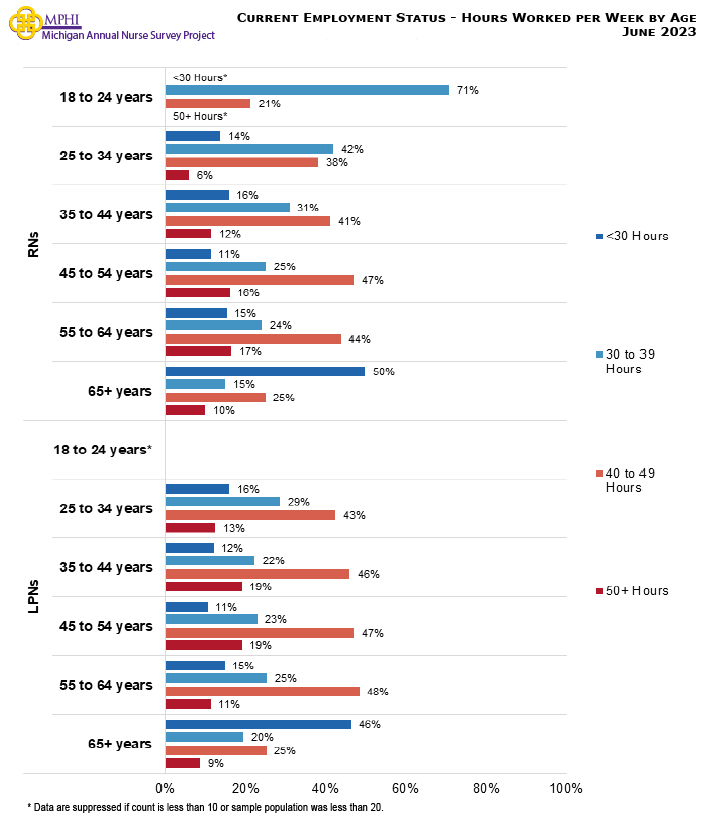
* Data are suppressed if count is less than 10 or sample population was less than 20.
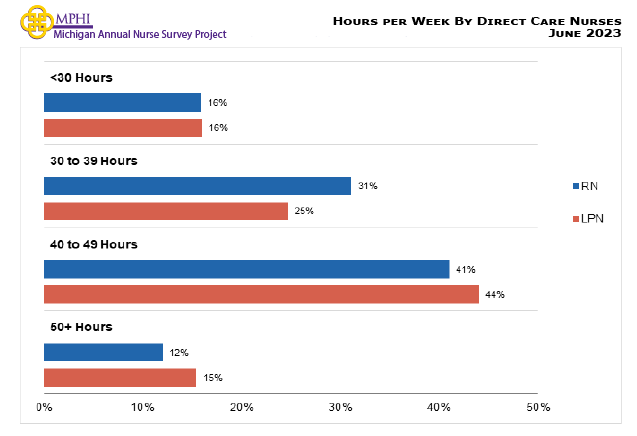
Hours Worked per Week by Direct Care Nurses
Number of Currently Employed Nursing Positions, 2023
| Number of Positions | RN = 14,492 | LPN = 1,307 | ||
|---|---|---|---|---|
| Estimate | 95% CI | Estimate | 95% CI | |
| 1 Position | 85.6% | (85.0%, 86.2%) | 78.7% | (76.4%, 80.8%) |
| 2 Position | 12.4% | (11.9%, 12.9%) | 16.9% | (15.0%, 19.0%) |
| 3+ Positions | 2.0% | (1.8%, 2.2%) | 4.4% | (3.4%, 5.7%) |
Number of Years Working as a Nurse
| Years | 2019 | 2021 | 2023 | |||
|---|---|---|---|---|---|---|
| RN = 12,224 | RN = 24,781 | RN = 14,000 | ||||
| Estimate | 95% CI | Estimate | 95% CI | Estimate | 95% CI | |
| Less than 3 years | 11.1% | (10.5%, 11.7%) | 11.9% | (11.5%, 12.3%) | 11.1% | (10.6%, 11.6%) |
| 3 to less than 10 years | 30.0% | (29.2%, 30.8%) | 29.2% | (28.6%, 29.8%) | 25.4% | (24.7%, 26.1%) |
| 10 to less than 20 years | 21.8% | (21.1%, 22.5%) | 23.6% | (23.1%, 24.1%) | 28.8% | (28.1%, 29.6%) |
| 20 or more years | 37.1% | (36.2%, 37.9%) | 35.3% | (34.7%, 35.9%) | 34.7% | (33.9%, 35.5%) |
| LPN = 1,317 | LPN = 2,895 | LPN = 1,236 | ||||
| Estimate | 95% CI | Estimate | 95% CI | Estimate | 95% CI | |
| Less than 3 years | 15.8% | (13.8%, 17.7%) | 17.8% | (16.4%, 19.2%) | 16.6% | (14.6%, 18.8%) |
| 3 to less than 10 years | 34.7% | (32.1%, 37.2%) | 31.4% | (29.7%, 33.1%) | 26.7% | (24.3%, 29.2%) |
| 10 to less than 20 years | 20.2% | (18.0%, 22.4%) | 22.8% | (21.3%, 24.4%) | 28.1% | (25.7%, 30.7%) |
| 20 or more years | 29.4% | (26.9%, 31.8%) | 28.0% | (26.4%, 29.7%) | 28.5% | (26.1%, 31.1%) |
| APN = 1,479 | APN = 2,758 | APN = 1,659 | ||||
| Estimate | 95% CI | Estimate | 95% CI | Estimate | 95% CI | |
| Less than 3 years | 2.5% | (01.7%, 03.3%) | 1.0% | (0.7%, 1.4%) | * | * |
| 3 to less than 10 years | 24.5% | (22.3%, 26.7%) | 24.4% | (22.8%, 26.0%) | 18.8% | (17.0%, 20.8%) |
| 10 to less than 20 years | 31.4% | (29.0%, 33.7%) | 33.6% | (31.8%, 35.3%) | 42.3% | (39.9%, 44.7%) |
| 20 or more years | 41.7% | (39.1%, 44.2%) | 41.1% | (39.3%, 42.9%) | 38.5% | (36.2%, 40.9%) |
Number of Years Working as APN by Age, 2023
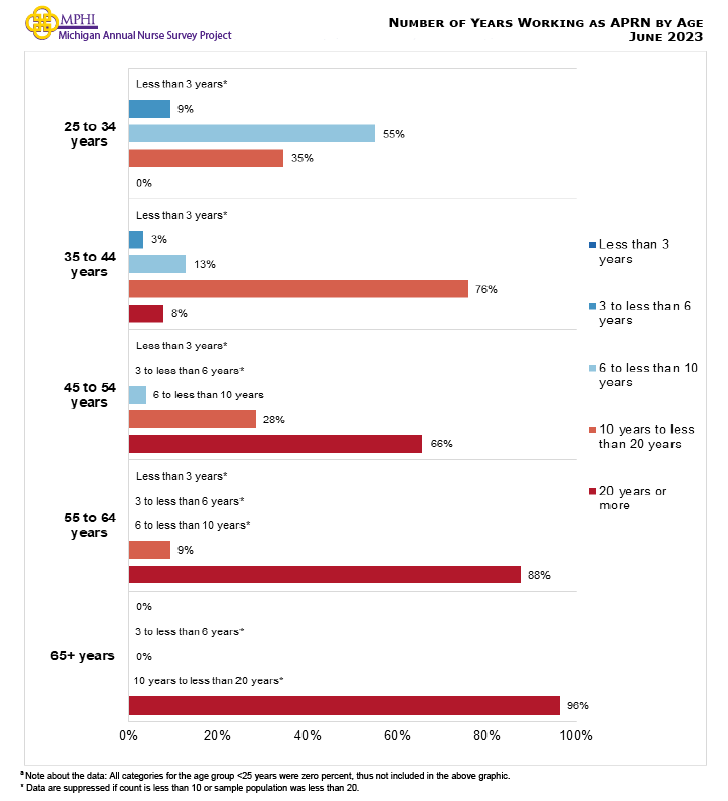
a Note about the data: All categories for the age group <25 years were zero percent, thus not included in the above graphic.
* Data are suppressed if count is less than 10 or sample population was less than 20.
Employer Supports
| Supports | RN = 13,919 | LPN = 1,223 | ||
|---|---|---|---|---|
| Estimate | 95% CI | Estimate | 95% CI | |
| None of the below | 23.7% | (23.0%, 24.4%) | 48.0% | (45.2%, 50.8%) |
| Tuition reimbursement | 61.6% | (60.8%, 62.4%) | 46.4% | (43.6%, 49.2%) |
| Paid time off for advancing nursing education | 4.8% | (4.5%, 5.2%) | 4.0% | (3.0%, 5.3%) |
| Paid time off for continuing education courses | 13.5% | (12.9%, 14.1%) | 3.7% | (2.8%, 4.9%) |
| Reimbursement for continuing education | 33.6% | (32.8%, 34.4%) | 16.8% | (14.8%, 19.0%) |
| Reimbursement for costs associated with obtaining advanced certification | 22.7% | (22.0%, 23.4%) | 5.1% | (4.0%, 6.5%) |
| Student loan repayment benefits | 10.8% | (10.3%, 11.3%) | 5.8% | (4.6%, 7.3%) |
| Nurse residency/Transitions to practice programs | 20.6% | (19.9%, 21.3%) | 3.0% | (2.2%, 4.1%) |
| Mentorship | 13.3% | (12.7%, 13.9%) | 4.5% | (3.5%, 5.8%) |
| Paid time off for advancing nursing education | 4.8% | (4.5%, 5.2%) | 4.0% | (3.0%, 5.3%) |
a Respondents were instructed to mark all that apply.
Employment Setting
Practice Setting: 2019, 2021, & 2023
| Setting | 2019 | 2021 | 2023 | |||
|---|---|---|---|---|---|---|
| RN = 10,699 | RN = 25,173 | RN = 14,513 | ||||
| Estimate | 95% CI | Estimate | 95% CI | Estimate | 95% CI | |
| Acute Care | 64.9% | (64.0%, 65.8%) | 52.9% | (52.3%, 53.5%) | 51.8% | (51.0%, 52.6%) |
| Ambulatory Care | 31.8% | (30.9%, 32.7%) | 20.1% | (19.6%, 20.6%) | 22.9% | (22.2%, 23.6%) |
| Community Health | 14.1% | (13.5%, 14.8%) | 5.5% | (5.2%, 5.8%) | 5.0% | (4.7%, 5.4%) |
| Corrections | 0.7% | (0.6%, 0.9%) | 0.8% | (0.7%, 0.9%) | 0.8% | (0.7%, 1.0%) |
| Emergent and Urgent Care | 12.9% | (12.3%, 13.5%) | 9.9% | (9.5%, 10.3%) | 11.0% | (10.5%, 11.5%) |
| Long-term Care | 7.1% | (6.6%, 7.6%) | 6.5% | (6.2%, 6.8%) | 5.4% | (5.0%, 5.8%) |
| Mobile and Home Care | 4.5% | (4.1%, 4.9%) | 5.5% | (5.2%, 5.8%) | 4.6% | (4.3%, 5.0%) |
| Non-clinical | 14.7% | (14.0%, 15.4%) | 9.4% | (9.0%, 9.8%) | 9.8% | (9.3%, 10.3%) |
| Public Health | 3.9% | (3.5%, 4.3%) | 4.0% | (3.8%, 4.2%) | 3.7% | (3.4%, 4.0%) |
| School of Nursing | – | – | 4.0% | (3.8%, 4.2%) | 4.3% | (4.0%, 4.6%) |
| School Health | 1.0% | (0.8%, 1.2%) | 1.2% | (1.1%, 1.3%) | 1.7% | (1.5%, 1.9%) |
| Other Community-based Health Care settings | 9.8% | (9.3%, 10.4%) | 3.8% | (3.6%, 4.0%) | 3.0% | (2.7%, 3.3%) |
| Other Community-based Care | 12.0% | (11.4%, 12.6%) | 2.5% | (2.3%, 2.7%) | 2.6% | (2.4%, 2.9%) |
| Setting | 2019 | 2021 | 2023 | |||
| LPN = 1,181 | LPN = 2,975 | LPN = 1,309 | ||||
| Estimate | 95% CI | Estimate | 95% CI | Estimate | 95% CI | |
| Acute Care | 36.4% | (33.7%, 39.2%) | 9.7% | (8.7%, 10.8%) | 11.7% | (10.1%, 13.6%) |
| Ambulatory Care | 27.7% | (25.2%, 30.3%) | 15.8% | (14.5%, 17.2%) | 17.3% | (15.3%, 19.4%) |
| Community Health | 31.0% | (28.4%, 33.7%) | 7.7% | (6.8%, 8.7%) | 8.7% | (7.3%, 10.4%) |
| Corrections | 2.3% | (1.6%, 3.3%) | 3.1% | (2.5%, 3.8%) | 3.4% | (2.5%, 4.5%) |
| Emergent and Urgent Care | 13.2% | (11.4%, 15.3%) | 2.1% | (1.6%, 2.7%) | 2.9% | (2.1%, 4.0%) |
| Long-term Care | 52.1% | (49.2%, 54.9%) | 50.9% | (49.1%, 52.7%) | 47.9% | (45.2%, 50.6%) |
| Mobile and Home Care | 15.3% | (13.4%, 17.5%) | 15.1% | (13.9%, 16.4%) | 13.9% | (12.1%, 15.9%) |
| Non-clinical | 16.3% | (14.3%, 18.5%) | 5.5% | (4.7%, 6.4%) | 6.8% | (5.6%, 8.3%) |
| Public Health | 4.5% | (3.5%, 5.8%) | 3.3% | (2.7%, 4.0%) | 3.4% | (2.5%, 4.5%) |
| School of Nursing | – | – | 1.5% | (1.1%, 2.0%) | 0.8% | (0.4%, 1.4%) |
| School Health | 2.3% | (1.6%, 3.3%) | 1.5% | (1.1%, 2.0%) | 2.9% | (2.1%, 4.0%) |
| Other Community-based Health Care settings | 25.7% | (23.3%, 28.3%) | 14.4% | (13.2%, 15.7%) | 16.5% | (14.6%, 18.6%) |
| Other Community-based Care | 11.2% | (9.5%, 13.1%) | 1.8% | (1.4%, 2.3%) | 2.0% | (1.4%, 2.9%) |
a Respondents were instructed to mark all that apply.
b Disclaimer: 2019 data categories and questions were structured differently compared to 2021 and 2023. Categories were mapped to 2021 and 2023 categories where it was possible.
c In 2021, Long-term Care was named Nursing Home/Extended Care.
d In 2021, Mobile and Home Care was named Mobile Care Unit.
– Category was not available.
Position and Role: 2019, 2021, 2023
| Position | 2019 | 2021 | 2023 | |||
|---|---|---|---|---|---|---|
| RN = 10,699 | RN = 25,092 | RN = 14,296 | ||||
| Estimate | 95% CI | Estimate | 95% CI | Estimate | 95% CI | |
| Staff Nurse | 17.1% | (16.4%, 17.8%) | 63.3% | (62.7%, 63.9%) | 58.2% | (57.4%, 59.0%) |
| Faculty | 3.4% | (3.1%, 3.8%) | 3.7% | (3.5%, 3.9%) | 3.7% | (3.4%, 4.0%) |
| Education, Research, & Consulting | 9.0% | (8.5%, 9.6%) | 7.6% | (7.3%, 7.9%) | 8.7% | (8.3%, 9.2%) |
| School Nurse | 1.0% | (0.8%, 1.2%) | 1.0% | (0.9%, 1.1%) | 1.5% | (1.3%, 1.7%) |
| Telehealth | – | – | 3.6% | (3.4%, 3.8%) | 4.0% | (3.7%, 4.3%) |
| Travel Nurse | 1.6% | (1.4%, 1.9%) | – | – | 4.5% | (4.2%, 4.8%) |
| Executives | 1.8% | (1.6%, 2.1%) | 4.5% | (4.3%, 4.8%) | 4.7% | (4.4%, 5.1%) |
| Patient Educator | 16.3% | (15.6%, 17.0%) | 5.4% | (5.1%, 5.7%) | 7.2% | (6.8%, 7.6%) |
| APRN and Nurse Anesthetist | 1.4% | (1.2%, 1.6%) | 8.3% | (8.0%, 8.6%) | 10.0% | (9.5%, 10.5%) |
| Managerial | 6.9% | (6.4%, 7.4%) | 8.4% | (8.1%, 8.7%) | 8.6% | (8.2%, 9.1%) |
| Military Health Services | – | – | 0.4% | (0.3%, 0.5%) | 0.5% | (0.4%, 0.6%) |
| Other Health Services | 14.1% | (13.5%, 14.8%) | 14.8% | (14.4%, 15.2%) | 15.4% | (14.8%, 16.0%) |
| Other Health Non-related | 6.4% | (6.0%, 6.9%) | 0.2% | (0.2%, 0.3%) | 0.3% | (0.2%, 0.4%) |
| Position | 2019 | 2021 | 2023 | |||
| LPN = 1,181 | LPN = 2,961 | LPN = 1,278 | ||||
| Estimate | 95% CI | Estimate | 95% CI | Estimate | 95% CI | |
| Staff Nurse | 26.3% | (23.9%, 28.9%) | 75.7% | (74.1%, 77.2%) | 74.9% | (72.5%, 77.2%) |
| Faculty | 7.0% | (5.7%, 8.6%) | 0.7% | (0.5%, 1.1%) | * | * |
| Education, Research, & Consulting | 7.8% | (6.4%, 9.5%) | 2.3% | (1.8%, 2.9%) | 2.7% | (2.0%, 3.7%) |
| School Nurse | 2.3% | (1.6%, 3.3%) | 1.7% | (1.3%, 2.2%) | 2.7% | (2.0%, 3.7%) |
| Telehealth | – | – | 2.6% | (2.1%, 3.2%) | 2.6% | (1.9%, 3.6%) |
| Travel Nurse | 3.0% | (2.2%, 4.1%) | – | – | 5.0% | (3.9%, 6.3%) |
| Executives | * | * | 2.8% | (2.3%, 3.5%) | 3.3% | (2.5%, 4.4%) |
| Patient Educator | 25.4% | (23.0%, 28.0%) | 6.0% | (5.2%, 6.9%) | 7.9% | (6.6%, 9.5%) |
| APRN and Nurse Anesthetist | * | * | * | * | 0.0% | (0.0%, 0.0%) |
| Managerial | 8.5% | (7.0%, 10.2%) | 14.5% | (13.3%, 15.8%) | 11.8% | (10.2%, 13.7%) |
| Military Health Services | – | – | 0.6% | (0.4%, 0.9%) | * | * |
| Other Health Services | 16.4% | (14.4%, 18.6%) | 11.5% | (10.4%, 12.7%) | 12.7% | (11.0%, 14.6%) |
| Other Health Non-related | 5.9% | (4.7%, 7.4%) | 0.3% | (0.2%, 0.6%) | * | * |
a Respondents were instructed to mark all that apply.
b Disclaimer: 2019 data categories and questions were structured differently compared to 2021 and 2023. Categories were mapped to 2021 and 2023 categories where it was possible.
c In 2021, Faculty also included Nurse Post Secondary Educators.
d In 2021, Education, Research, & Consulting also included the following: Nurse Secondary Educator, Professional Nurse Training, Nurse Consultant, & Nurse Researcher.
e In 2021, School Nurse was named School Health Nurse K-12.
f In 2021, Executives was named Nurse Executive/Administrator.
g In 2021, Managerial was named Nurse Manager/Supervisor.
h In 2021, this category was named Reserve and Active Military.
i In 2021, Other Health Services was named Other Health Related.
* Data are suppressed if count is less than 10 or sample population was less than 20.
-Category was not available.
Specialties: 2019, 2021, 2023
| Specialty | 2019 | 2021 | 2023 | |||
|---|---|---|---|---|---|---|
| RN = 10,699 | RN = 24,839 | RN = 14,158 | ||||
| % | 95% CI | % | 95% CI | % | 95% CI | |
| Academia | 3.4% | (3.1%, 3.8%) | 3.6% | (3.4%, 3.8%) | 3.5% | (3.2%, 3.8%) |
| Adult Health | 5.1% | (4.7%, 5.5%) | 20.3% | (19.8%, 20.8%) | 20.7% | (20.0%, 21.4%) |
| Anesthesia | 1.4% | (1.2%, 1.6%) | 2.6% | (2.4%, 2.8%) | 3.5% | (3.2%, 3.8%) |
| Behavioral Health | 6.9% | (6.4%, 7.4%) | 5.5% | (5.2%, 5.8%) | 6.3% | (5.9%, 6.7%) |
| Care Management | 14.7% | (14.0%, 15.4%) | 9.4% | (9.0%, 9.8%) | 11.9% | (11.4%, 12.4%) |
| Child & Family Health | 9.9% | (9.3%, 10.5%) | 10.3% | (9.9%, 10.7%) | 11.8% | (11.3%, 12.3%) |
| Community Care | 4.9% | (4.5%, 5.3%) | 4.0% | (3.8%, 4.2%) | 4.1% | (3.8%, 4.4%) |
| Critical Care | 14.1% | (13.5%, 14.8%) | 16.2% | (15.7%, 16.7%) | 17.1% | (16.5%, 17.7%) |
| Dialysis Nurse | 3.0% | (2.7%, 3.3%) | 1.9% | (1.7%, 2.1%) | 1.6% | (1.4%, 1.8%) |
| Geriatric Care | 11.5% | (10.9%, 12.1%) | 9.4% | (9.0%, 9.8%) | 9.3% | (8.8%, 9.8%) |
| Hospice | 7.1% | (6.6%, 7.6%) | 3.9% | (3.7%, 4.1%) | 4.5% | (4.2%, 4.8%) |
| Medical-Surgical & Wound Care | 16.2% | (15.5%, 16.9%) | 18.6% | (18.1%, 19.1%) | 17.1% | (16.5%, 17.7%) |
| Occupational Health and Transitions of Care | 3.2% | (2.9%, 3.6%) | 3.3% | (3.1%, 3.5%) | 4.3% | (4.0%, 4.6%) |
| Other | 9.7% | (9.2%, 10.3%) | 10.7% | (10.3%, 11.1%) | 11.6% | (11.1%, 12.1%) |
| Other Non-clinical Specialties | 12.3% | (11.7%, 12.9%) | 2.2% | (2.0%, 2.4%) | 2.0% | (1.8%, 2.2%) |
| Phlebotomy, Testing, & Diagnostics | 3.7% | (3.4%, 4.1%) | 1.4% | (1.3%, 1.6%) | 2.2% | (2.0%, 2.5%) |
| Rehabilitation | 4.3% | (3.9%, 4.7%) | 4.3% | (4.1%, 4.6%) | 3.6% | (3.3%, 3.9%) |
| Specialty Care | 23.9% | (23.1%, 24.7%) | 14.0% | (13.6%, 14.4%) | 14.7% | (14.1%, 15.3%) |
| Surgical Services | 8.1% | (7.6%, 8.6%) | 10.1% | (9.7%, 10.5%) | 10.9% | (10.4%, 11.4%) |
| Women & Infants Health | 10.8% | (10.2%, 11.4%) | 8.8% | (8.5%, 9.2%) | 9.4% | (8.9%, 9.9%) |
| Specialty | 2019 | 2021 | 2023 | |||
| LPNs = 1,181 | LPNs = 2,911 | LPNs = 1,253 | ||||
| % | 95% CI | % | 95% CI | % | 95% CI | |
| Academia | 7.0% | (5.7%, 8.6%) | 3.1% | (2.5%, 3.8%) | 1.7% | (1.1%, 2.6%) |
| Adult Health | 9.5% | (8.0%, 11.3%) | 39.6% | (37.9%, 41.4%) | 36.2% | (33.6%, 38.8%) |
| Anesthesia | * | * | * | * | 0.0% | (0.0%, 0.0%) |
| Behavioral Health | 11.6% | (9.9%, 13.6%) | 6.7% | (5.9%, 7.7%) | 7.7% | (6.4%, 9.3%) |
| Care Management | 16.6% | (14.6%, 18.8%) | 4.5% | (3.8%, 5.3%) | 5.3% | (4.2%, 6.6%) |
| Child & Family Health | 16.6% | (14.6%, 18.8%) | 14.0% | (12.8%, 15.3%) | 13.8% | (12.0%, 15.8%) |
| Community Care | 11.0% | (9.3%, 12.9%) | 6.1% | (5.3%, 7.0%) | 5.3% | (4.2%, 6.6%) |
| Critical Care | 7.0% | (5.7%, 8.6%) | 3.3% | (2.7%, 4.0%) | 3.0% | (2.2%, 4.1%) |
| Dialysis Nurse | 5.8% | (4.6%, 7.3%) | 1.3% | (1.0%, 1.8%) | 0.9% | (0.5%, 1.6%) |
| Geriatric Care | 46.1% | (43.3%, 49.0%) | 39.5% | (37.8%, 41.3%) | 41.5% | (38.9%, 44.2%) |
| Hospice | 21.4% | (19.2%, 23.8%) | 6.4% | (5.6%, 7.3%) | 9.7% | (8.2%, 11.4%) |
| Medical-Surgical & Wound Care | 8.3% | (6.9%, 10.0%) | 16.2% | (14.9%, 17.6%) | 22.9% | (20.7%, 25.3%) |
| Occupational Health and Transitions of Care | 11.1% | (9.4%, 13.0%) | 3.9% | (3.3%, 4.7%) | 4.9% | (3.9%, 6.2%) |
| Other | 6.0% | (4.8%, 7.5%) | 11.2% | (10.1%, 12.4%) | 15.2% | (13.4%, 17.2%) |
| Other non-clinical specialties | 26.9% | (24.4%, 29.5%) | 1.4% | (1.0%, 1.9%) | 2.1% | (1.5%, 3.0%) |
| Phlebotomy, Testing, & Diagnostics | 3.2% | (2.3%, 4.4%) | 3.2% | (2.6%, 3.9%) | 4.7% | (3.7%, 6.0%) |
| Rehabilitation | 22.9% | (20.6%, 25.4%) | 17.9% | (16.6%, 19.3%) | 18.2% | (16.2%, 20.4%) |
| Specialty Care | 17.7% | (15.6%, 20.0%) | 3.4% | (2.8%, 4.1%) | 5.4% | (4.3%, 6.8%) |
| Surgical Services | 2.2% | (1.5%, 3.2%) | 1.7% | (1.3%, 2.2%) | 1.3% | (0.8%, 2.1%) |
| Women & Infants Health | 6.2% | (5.0%, 7.7%) | 1.7% | (1.3%, 2.2%) | 2.4% | (1.7%, 3.4%) |
a Respondents were instructed to mark all that apply.
b Disclaimer: 2019 data categories and questions were structured differently compared to 2021 and 2023. Categories were mapped to 2021 and 2023 categories where it was possible.
c In 2021, Behavioral Health was named Psychiatric/Mental Health/Substance Abuse.
d In 2021, Care Management included Care Management/Care Coordination & Health Clinical Informatics.
e In 2021, Child & Family Health included Pediatrics & Family Health.
f In 2021, Hospice also included Palliative Care.
g In 2021, Other included: Other Medical, Other Clinical Specialties, Flight Nurse, and Other.
h In 2021, Specialty Care included: Cardiology, Hematology, Oncology, Nephrology & Thoracic Care.
i In 2021, Surgical Services included: Pre-op/Post-op Recovery Room & Operating Room/Scrub Nurse.
j In 2021, Women & Infants Health included: Women’s Health, Maternal-Child Health/Obstetrics, & Neonatal.
* Data are suppressed if count is less than 10 or sample population was less than 20.
Change in Employment Setting: 2019, 2021, & 2023
| Change in Employment Setting | 2019 | 2021 | 2023 | |||
|---|---|---|---|---|---|---|
| RN = 11,605 | RN = 24,474 | RN = 14,041 | ||||
| Estimate | 95% CI | Estimate | 95% CI | Estimate | 95% CI | |
| Did not make a change | 57.3% | (55.9%, 58.7%) | 61.5% | (60.9%, 62.1%) | 54.4% | (53.6%, 55.2%) |
| Among those who DID make a change: | ||||||
| An inpatient setting to a community-based setting? | – | – | 12.9% | (12.2%, 13.6%) | 6.1% | (5.7%, 6.5%) |
| An inpatient setting to an outpatient setting? | 18.0% | (17.0%, 19.1%) | – | – | – | – |
| An outpatient setting to an inpatient setting? | 4.9% | (4.4%, 5.6%) | – | – | – | – |
| A community-based setting to an inpatient setting? | – | – | 4.2% | (3.8%, 4.6%) | 1.8% | (1.6%, 2.0%) |
| A primary care setting (e.g., family practice, general medicine) to a specialty care setting? | 4.2% | (3.7%, 4.8%) | 4.4% | (4.0%, 4.8%) | 2.0% | (1.8%, 2.2%) |
| A specialty care setting to a primary care setting? | 2.0% | (1.7%, 2.5%) | 2.9% | (2.6%, 3.3%) | 1.5% | (1.3%, 1.7%) |
| A sub-acute care setting to an acute care setting? | 3.4% | (2.9%, 4.0%) | 3.5% | (3.1%, 3.9%) | 1.3% | (1.1%, 1.5%) |
| An acute care setting to a sub-acute care setting? | 2.1% | (1.8%, 2.6%) | 3.7% | (3.3%, 4.1%) | 1.8% | (1.6%, 2.0%) |
| A direct patient care setting to a non-direct patient care setting? | 13.7% | (12.7%, 14.7%) | 12.2% | (11.5%, 12.9%) | 6.3% | (5.9%, 6.7%) |
| A non-direct patient care setting to a direct patient care setting? | 4.8% | (4.2%, 5.4%) | 4.1% | (3.7%, 4.5%) | 2.2% | (2.0%, 2.5%) |
| I changed locations but stayed in the same care setting. | 27.7% | (26.5%, 29.0%) | 28.3% | (27.4%, 29.2%) | 13.4% | (12.8%, 14.0%) |
| Some other type of change in employment. | 29.9% | (28.7%, 31.2%) | 33.3% | (32.3%, 34.3%) | 15.0% | (14.4%, 15.6%) |
| Change in Employment Setting | 2019 | 2021 | 2023 | |||
| LPN = 1,239 | LPN = 2,846 | LPN = 1,242 | ||||
| Estimate | 95% CI | Estimate | 95% CI | Estimate | 95% CI | |
| Did not make a change | 53.1% | (49.0%, 57.2%) | 61.2% | (59.4%, 63.0%) | 56.8% | (54.0%, 59.5%) |
| Among those who DID make a change: | ||||||
| An inpatient setting to a community-based setting | – | – | 10.1% | (8.4%, 12.0%) | 3.0% | (2.2%, 4.1%) |
| An inpatient setting to an outpatient setting? | 13.7% | (11.1%, 16.8%) | – | – | – | – |
| An outpatient setting to an inpatient setting? | 6.1% | (4.4%, 8.4%) | – | – | – | – |
| A community-based setting to an inpatient setting | – | – | 4.5% | (3.4%, 5.9%) | 2.1% | (1.4%, 3.1%) |
| A primary care setting (e.g., family practice, general medicine, internal medicine, or general pediatrics) to a specialty | 5.8% | (4.2%, 8.1%) | 5.9% | (4.6%, 7.5%) | 2.5% | (1.8%, 3.5%) |
| A specialty care setting to a primary care setting | 3.9% | (2.6%, 5.8%) | 3.9% | (2.9%, 5.2%) | 2.6% | (1.9%, 3.6%) |
| A sub-acute care setting to an acute care setting | 2.5% | (1.5%, 4.2%) | 3.1% | (2.2%, 4.3%) | 2.1% | (1.4%, 3.1%) |
| An acute care setting to a sub-acute care setting | 2.2% | (1.3%, 3.8%) | 2.8% | (2.0%, 4.0%) | * | * |
| A direct patient care setting to a non-direct patient care setting | 9.9% | (7.7%, 12.6%) | 8.1% | (6.6%, 9.9%) | 4.6% | (3.6%, 5.9%) |
| A non-direct patient care setting to a direct patient care setting | 6.9% | (5.1%, 9.3%) | 5.6% | (4.4%, 7.1%) | 2.1% | (1.4%, 3.1%) |
| I changed locations but stayed in the same care setting | 32.8% | (29.1%, 36.8%) | 32.1% | (29.4%, 34.9%) | 15.8% | (13.9%, 17.9%) |
| I made some other type of employment change | 28.8% | (25.2%, 32.6%) | 34.8% | (32.0%, 37.7%) | 13.5% | (11.7%, 15.5%) |
a Respondents were instructed to mark all that apply.
* Data are suppressed if count is less than 10 or sample population was less than 20.
– Category was not available
Reason for Change in Employment
| Reason | 2023 | |||
|---|---|---|---|---|
| RN = 5,649 | LPN = 508 | |||
| Estimate | 95% CI | Estimate | 95% CI | |
| Preparing to retire | 5.4% | (4.8%, 6.0%) | 5.4% | (3.7%, 7.7%) |
| Care for home or family | 13.7% | (12.8%, 14.6%) | 9.0% | (6.8%, 11.8%) |
| Completed educational program | 8.7% | (8.0%, 9.5%) | 6.8% | (4.9%, 9.3%) |
| Changing to preferred nursing position | 27.0% | (25.9%, 28.2%) | 21.9% | (18.5%, 25.7%) |
| Seeking a less stressful position/setting | 44.8% | (43.5%, 46.1%) | 42.5% | (38.3%, 46.8%) |
| Difficulties with EMR/New technology | 0.5% | (0.3%, 0.7%) | * | * |
| Violence/safety Issues | 10.1% | (9.3%, 10.9%) | 4.2% | (2.8%, 6.3%) |
| Relocating/moving to another area | 11.7% | (10.9%, 12.6%) | 8.4% | (6.3%, 11.1%) |
| COVID-related | 9.6% | (8.9%, 10.4%) | 8.4% | (6.3%, 11.1%) |
| Temporary disability or long-term illness | 1.4% | (1.1%, 1.7%) | * | * |
| Permanent disability leave | * | * | * | * |
| Wages | 28.3% | (27.1%, 29.5%) | 33.8% | (29.8%, 38.0%) |
| Work culture | 32.5% | (31.3%, 33.7%) | 25.2% | (21.6%, 29.2%) |
| Workload | 31.8% | (30.6%, 33.0%) | 27.8% | (24.1%, 31.9%) |
| Better schedule | 43.4% | (42.1%, 44.7%) | 38.2% | (34.1%, 42.5%) |
| Benefits and employer supports | 16.6% | (15.7%, 17.6%) | 16.5% | (13.5%, 20.0%) |
| Other | 7.4% | (6.7%, 8.1%) | 7.0% | (5.1%, 9.6%) |
a Respondents were instructed to mark all that apply.
b Note: This question was not asked in 2019 or 2021, so comparisons cannot be made.
* Data are suppressed if count is less than 10 or sample population was less than 20.
Plans to Continue Nursing
Plans to Continue Working as a Nurse: 2017, 2019, 2021, & 2023
| Years | 2017 | 2019 | 2021 | 2023 | ||||
|---|---|---|---|---|---|---|---|---|
| RN = 26,150 | RN = 12,213 | RN = 24,739 | RN = 14,373 | |||||
| Estimate | 95% CI | Estimate | 95% CI | Estimate | 95% CI | Estimate | 95% CI | |
| Less than 2 years | 4.6% | (4.4%, 4.9%) | 4.9% | (4.5%, 5.3%) | 5.7% | (5.4%, 6.0%) | 7.6% | (7.2%, 8.0%) |
| 2 to 5 years | 13.4% | (12.9%, 13.8%) | 13.0% | (12.4%, 13.6%) | 12.7% | (12.2%, 13.1%) | 14.0% | (13.4%, 14.6%) |
| 6 to 10 years | 16.0% | (15.6%, 16.5%) | 14.9% | (14.3%, 15.5%) | 15.3% | (14.9%, 15.8%) | 15.9% | (15.3%, 16.5%) |
| More than 10 years | 60.2% | (59.7%, 60.8%) | 61.2% | (60.4%, 62.1%) | 59.5% | (58.9%, 60.1%) | 51.8% | (51.0%, 52.6%) |
| Do not know | 5.7% | (5.5%, 6.0%) | 5.9% | (5.5%, 6.3%) | 6.9% | (6.6%, 7.2%) | 10.6% | (10.1%, 11.1%) |
| Years | 2017 | 2019 | 2021 | 2023 | ||||
| LPN = 4,251 | LPN = 1,314 | LPN = 2,878 | LPN = 1,273 | |||||
| Estimate | 95% CI | Estimate | 95% CI | Estimate | 95% CI | Estimate | 95% CI | |
| Less than 2 years | 3.9% | (3.3%, 4.5%) | 5.4% | (4.2%, 6.6%) | 5.1% | (4.4%, 6.0%) | 6.8% | (5.5%, 8.3%) |
| 2 to 5 years | 13.1% | (12.1%, 14.1%) | 14.2% | (12.3%, 16.1%) | 12.0% | (10.8%, 13.2%) | 12.3% | (10.6%, 14.2%) |
| 6 to 10 years | 14.1% | (13.0%, 15.1%) | 13.9% | (12.0%, 15.8%) | 13.5% | (12.3%, 14.8%) | 15.3% | (13.4%, 17.4%) |
| More than 10 years | 59.0% | (57.6%, 60.5%) | 56.7% | (54.0%, 59.4%) | 56.6% | (54.8%, 58.4%) | 50.5% | (47.8%, 53.2%) |
| Do not know | 9.9% | (9.0%, 10.8%) | 9.9% | (8.2%, 11.5%) | 12.8% | (11.7%, 14.1%) | 15.1% | (13.2%, 17.2%) |
Plans to Work Five Years or Less by Setting: 2019, 2021, & 2023
| Setting | 2019 | 2021 | 2023 | |||||||
|---|---|---|---|---|---|---|---|---|---|---|
| RN = 3,351 | RN = 6,834 | RN = 5,449 | ||||||||
| N | % | 95% CI | N | % | 95% CI | N | % | 95% CI | ||
| Acute Care | 1,102 | 14.7% | (12.7%, 16.9%) | 2,215 | 15.6% | (14.1%, 17.2%) | 1,792 | 21.0% | (20.0%, 22.1%) | |
| Emergent and Urgent Care | 201 | 14.0% | (9.9%, 19.5%) | 351 | 12.6% | (9.5%, 16.5%) | 318 | 18.7% | (16.6%, 21.0%) | |
| Corrections | 21 | 26.6% | (12.5%, 48.0%) | 41 | 17.3% | (8.7%, 31.5%) | 39 | 30.7% | (22.7%, 40.1%) | |
| Long-term Care | 128 | 15.7% | (10.4%, 23.0%) | 296 | 15.9% | (12.2%, 20.5%) | 267 | 24.1% | (21.2%, 27.3%) | |
| Ambulatory Care | 545 | 14.5% | (11.8%, 17.7%) | 1,276 | 20.7% | (18.6%, 23.0%) | 1,089 | 22.2% | (20.8%, 23.7%) | |
| Mobile and Home Care | 112 | 20.7% | (14.2%, 29.1%) | 340 | 19.5% | (15.6%, 24.0%) | 263 | 25.1% | (22.0%, 28.5%) | |
| Non-clinical | 366 | 21.1% | (17.2%, 25.6%) | 761 | 26.8% | (23.8%, 30.1%) | 623 | 28.3% | (26.1%, 30.6%) | |
| School of Nursing | – | – | – | 299 | 24.0% | (19.5%, 29.2%) | 252 | 25.6% | (22.4%, 29.1%) | |
| Public Health | 86 | 17.7% | (11.1%, 27.1%) | 315 | 26.5% | (21.9%, 31.6%) | 160 | 20.8% | (17.5%, 24.6%) | |
| Community Health | 277 | 15.9% | (12.1%, 20.7%) | 370 | 21.8% | (17.9%, 26.3%) | 239 | 23.2% | (20.1%, 26.6%) | |
| School Health | 29 | 24.1% | (12.2%, 42.1%) | 89 | 25.6% | (17.7%, 35.5%) | 71 | 21.0% | (16.0%, 27.0%) | |
| Other Community-based Healthcare | 190 | 17.3% | (12.6%, 23.3%) | 282 | 23.9% | (19.3%, 29.2%) | 196 | 28.7% | (24.8%, 33.0%) | |
| Other Community-based Care | 294 | 20.6% | (16.4%, 25.6%) | 199 | 26.9% | (21.2%, 33.5%) | 140 | 25.6% | (21.5%, 30.2%) | |
| Setting | 2019 | 2021 | 2023 | |||||||
| LPN = 421 | LPN = 701 | LPN = 407 | ||||||||
| N | % | 95% CI | N | % | 95% CI | N | % | 95% CI | ||
| Acute Care | 61 | 15.9% | (8.8%, 27.0%) | 59 | 21.9% | (13.2%, 34.0%) | 24 | 12.8% | (7.8%, 20.2%) | |
| Emergent and Urgent Care | 23 | 15.4% | (5.8%, 34.9%) | 11 | 19.2% | (5.6%, 48.7%) | * | * | * | |
| Corrections | * | * | * | 12 | 13.9% | (3.5%, 41.8%) | 12 | 32.2% | (18.3%, 50.1%) | |
| Long-term Care | 70 | 13.3% | (7.2%, 23.2%) | 206 | 14.9% | (10.7%, 20.4%) | 108 | 18.4% | (15.1%, 22.3%) | |
| Ambulatory Care | 53 | 17.4% | (9.5%, 29.7%) | 127 | 26.0% | (19.2%, 34.3%) | 80 | 25.7% | (20.1%, 32.2%) | |
| Mobile and Home Care | 33 | 21.6% | (10.9%, 38.2%) | 82 | 19.4% | (12.3%, 29.2%) | 57 | 26.3% | (19.9%, 33.8%) | |
| Non-clinical | 40 | 22.6% | (12.4%, 37.6%) | 44 | 26.4% | (15.7%, 40.9%) | 23 | 18.9% | (11.6%, 29.3%) | |
| School of Nursing | – | – | – | * | * | * | * | * | * | |
| Public Health | * | * | * | 11 | 13.3% | (3.1%, 42.5%) | * | * | * | |
| Community Health | 49 | 14.2% | (7.0%, 26.6%) | 36 | 16.2% | (7.6%, 31.4%) | 22 | 14.1% | (8.2%, 23.2%) | |
| School Health | * | * | * | * | * | * | * | * | * | |
| Other Community-based Healthcare | 40 | 13.8% | (6.3%, 27.7%) | 80 | 19.0% | (11.9%, 28.9%) | 54 | 25.0% | (18.9%, 32.2%) | |
| Other Community-based Care | 34 | 27.2% | (15.1%, 43.9%) | 16 | 31.0% | (14.0%, 55.4%) | * | * | * | |
a Respondents were instructed to mark all that apply.
b Disclaimer: 2019 data categories and questions were structured differently compared to 2021 and 2023. Categories were mapped to 2021 and 2023 categories where it was possible.
c In 2021, Long-term Care was named Nursing Home/Extended Care.
d In 2021, Mobile and Home Care was named Mobile Care Unit.
– Categories were not available.
* Data are suppressed if count is less than 10 or sample population was less than 20.
Plans to Work Five Years or Less by Setting and Age, 2023
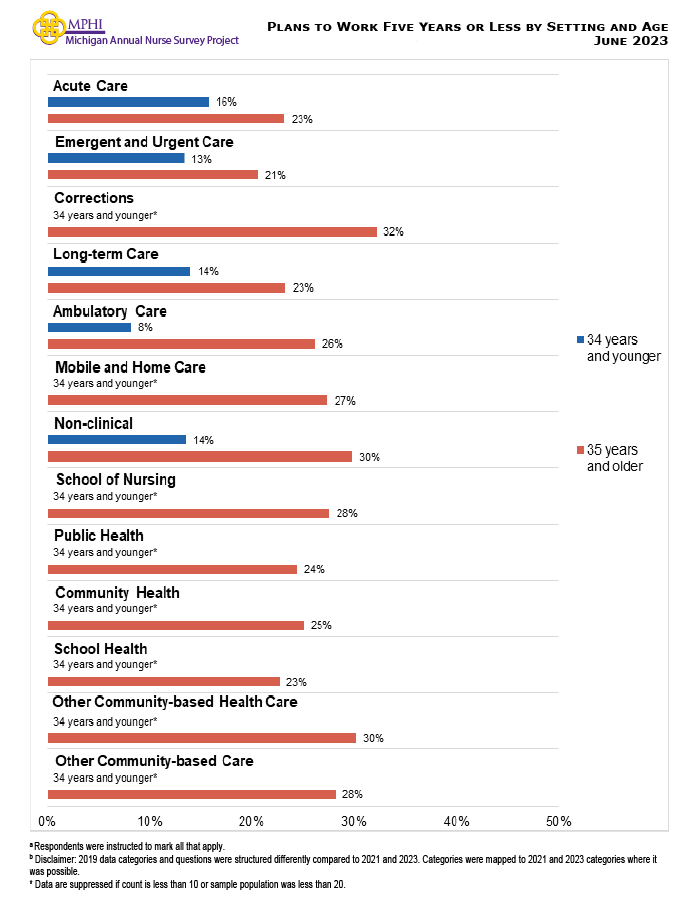
a Respondents were instructed to mark all that apply.
b Disclaimer: 2019 data categories and questions were structured differently compared to 2021 and 2023. Categories were mapped to 2021 and 2023 categories where it was possible.
* Data are suppressed if count is less than 10 or sample population was less than 20.
Plans to Work Five Years or Less by Position: 2019, 2021, & 2023
| Position | 2019 | 2021 | 2023 | ||||||
|---|---|---|---|---|---|---|---|---|---|
| RN = 1,596 | RN = 6,842 | RN = 5,633 | |||||||
| N | % | 95% CI | N | % | 95% CI | N | % | 95% CI | |
| Staff Nurse | 273 | 14.2% | (10.6%, 18.8%) | 2,921 | 17.0% | (15.7%, 18.4%) | 2,154 | 22.1% | (21.1%, 23.1%) |
| Faculty | 87 | 20.2% | (13.1%, 29.8%) | 292 | 25.0% | (20.4%, 30.3%) | 216 | 25.9% | (22.4%, 29.7%) |
| Education, Research, & Consulting | 240 | 21.0% | (16.3%, 26.6%) | 600 | 25.1% | (21.8%, 28.7%) | 509 | 25.6% | (23.3%, 28.1%) |
| School Nurse | 29 | 24.1% | (12.2%, 42.1%) | 65 | 22.1% | (13.7%, 33.6%) | 63 | 21.7% | (16.4%, 28.2%) |
| Telehealth | – | – | – | 218 | 20.8% | (15.9%, 26.7%) | 170 | 20.7% | (17.5%, 24.3%) |
| Travel Nurse | 34 | 20.5% | (10.3%, 36.7%) | – | – | – | 126 | 28.7% | (24.6%, 33.2%) |
| Executives | 55 | 23.3% | (14.1%, 36.0%) | 332 | 23.7% | (19.4%, 28.6%) | 283 | 27.8% | (24.7%, 31.2%) |
| Patient Educator | 247 | 13.1% | (9.5%, 17.9%) | 374 | 22.3% | (18.4%, 26.8%) | 404 | 25.9% | (23.3%, 28.7%) |
| APRN and Nurse Anesthetist | 30 | 12.8% | (5.0%, 29.0%) | 456 | 14.6% | (11.7%, 18.1%) | 407 | 15.7% | (13.9%, 17.7%) |
| Managerial | 144 | 17.6% | (12.2%, 24.6%) | 428 | 17.6% | (14.3%, 21.5%) | 349 | 20.3% | (18.1%, 22.7%) |
| Military Health Services | – | – | – | 23 | 21.0% | (9.2%, 41.1%) | 17 | 23.7% | (14.5%, 36.2%) |
| Other Health Services | 284 | 16.8% | (12.9%, 21.6%) | 1,113 | 25.2% | (22.7%, 27.8%) | 919 | 26.8% | (25.0%, 28.7%) |
| Other Health Non-related | 173 | 23.1% | (17.4%, 29.9%) | 20 | 25.7% | (11.6%, 47.6%) | 16 | 38.0% | (22.7%, 56.1%) |
| Position | 2019 | 2021 | 2023 | ||||||
| LPN = 184 | LPN = 650 | LPN = 422 | |||||||
| N | % | 95% CI | N | % | 95% CI | N | % | 95% CI | |
| Staff Nurse | 45 | 16.7% | (8.5%, 30.1%) | 381 | 17.9% | (14.4%, 22.1%) | 205 | 19.1% | (16.4%, 22.1%) |
| Faculty | 11 | 14.4% | (3.5%, 43.7%) | * | * | * | * | * | * |
| Education, Research, & Consulting | 15 | 19.7% | (6.9%, 44.9%) | 21 | 25.8% | (11.9%, 47.2%) | 18 | 46.3% | (31.0%, 62.4%) |
| School Nurse | * | * | * | 11 | 19.2% | (5.6%, 48.7%) | * | * | * |
| Telehealth | – | – | – | 19 | 22.1% | (9.1%, 44.4%) | * | * | * |
| Travel Nurse | * | * | * | – | – | – | 12 | 24.5% | (13.8%, 39.7%) |
| Executives | 0 | 0 | (0.0%, 0.0%) | 17 | 22.6% | (9.0%, 46.3%) | * | * | * |
| Patient Educator | 42 | 15.3% | (7.4%, 29.0%) | 37 | 21.5% | (11.3%, 37.1%) | 43 | 34.3% | (25.4%, 44.5%) |
| APRN and Nurse Anesthetist | * | * | * | 0 | 0 | (0.0%, 0.0%) | 0 | 0.0% | (0.0%, 0.0%) |
| Managerial | 12 | 12.8% | (3.1%, 40.6%) | 58 | 13.9% | (7.2%, 25.1%) | 42 | 23.7% | (17.3%, 31.6%) |
| Military Health Services | – | – | – | * | * | * | * | * | * |
| Other Health Services | 24 | 13.7% | (5.0%, 32.4%) | 89 | 27.4% | (19.2%, 37.5%) | 64 | 26.3% | (20.1%, 33.6%) |
| Other Health Non-related | 24 | 34.2% | (18.6%, 54.1%) | * | * | * | * | * | * |
a Respondents were instructed to mark all that apply.
b Disclaimer: 2019 data categories and questions were structured differently compared to 2021 and 2023. Categories were mapped to 2021 and 2023 categories where it was possible.
c In 2021, Faculty also included Nurse Post Secondary Educators.
d In 2021, Education, Research, & Consulting also included the following: Nurse Secondary Educator, Professional Nurse Training, Nurse Consultant, & Nurse Researcher.
e In 2021, School Nurse was named School Health Nurse K-12.
f In 2021, Executives was named Nurse Executive/Administrator.
g In 2021, Managerial was named Nurse Manager/Supervisor.
h In 2021, Military Health Services was named Reserve and Active Military.
i In 2021, Other Health Services was named Other Health Related.
* Data are suppressed if count is less than 10 or sample population was less than 20.
-Response option was not available.
Plans to Work Five Years or Less by Specialty: 2019, 2021, & 2023
| Specialty | 2019 | 2021 | 2023 | ||||||
|---|---|---|---|---|---|---|---|---|---|
| RN = 4,004 | RN = 7,973 | RN = 3,883 | |||||||
| N | % | 95% CI | N | % | 95% CI | N | % | 95% CI | |
| Academia | 87 | 20.2% | (13.1%, 29.8%) | 284 | 24.9% | (20.2%, 30.2%) | 219 | 27.2% | (23.6%, 31.2%) |
| Adult Health | 96 | 15.3% | (9.4%, 23.8%) | 858 | 15.0% | (12.8%, 17.5%) | 820 | 21.3% | (19.7%, 23.0%) |
| Anesthesia | 30 | 12.8% | (5.0%, 29.0%) | 160 | 18.2% | (13.0%, 24.9%) | 146 | 19.6% | (16.2%, 23.5%) |
| Behavioral Health | 136 | 15.8% | (10.6%, 22.9%) | 312 | 18.7% | (14.8%, 23.4%) | 249 | 21.2% | (18.5%, 24.2%) |
| Care Managementd | 299 | 17.1% | (13.3%, 21.8%) | 624 | 22.4% | (19.3%, 25.8%) | 639 | 24.9% | (22.9%, 27.0%) |
| Child & Family Healthe | 151 | 12.3% | (8.0%, 18.5%) | 463 | 15.4% | (12.4%, 19.0%) | 417 | 18.1% | (16.2%, 20.2%) |
| Community Care | 86 | 14.0% | (8.2%, 22.9%) | 282 | 23.3% | (18.7%, 28.6%) | 184 | 22.6% | (19.3%, 26.3%) |
| Critical Care | 193 | 13.0% | (9.0%, 18.5%) | 601 | 15.7% | (13.0%, 18.8%) | 528 | 23.4% | (21.5%, 25.4%) |
| Dialysis Nurse | 38 | 10.7% | (4.3%, 24.3%) | 69 | 12.3% | (6.5%, 22.1%) | 76 | 25.4% | (20.0%, 31.6%) |
| Geriatric Care | 176 | 13.7% | (9.4%, 19.6%) | 426 | 15.9% | (12.7%, 19.7%) | 386 | 21.0% | (18.8%, 23.4%) |
| Hospic | 114 | 13.1% | (8.1%, 20.5%) | 202 | 17.5% | (12.9%, 23.3%) | 192 | 24.1% | (20.7%, 27.8%) |
| Medical-Surgical & Wound Care | 187 | 10.4% | (6.8%, 15.6%) | 621 | 12.8% | (10.4%, 15.7%) | 518 | 19.4% | (17.6%, 21.3%) |
| Occupational Health and Transitions of Care | 57 | 15.0% | (8.0%, 26.5%) | 209 | 20.1% | (15.2%, 26.1%) | 155 | 18.7% | (15.6%, 22.3%) |
| Other | 235 | 20.3% | (15.7%, 25.9%) | 771 | 24.2% | (21.3%, 27.3%) | 680 | 27.8% | (25.7%, 30.0%) |
| Other non-clinical specialties | 256 | 16.9% | (12.8%, 22.0%) | 170 | 24.7% | (18.8%, 31.7%) | 127 | 28.7% | (23.8%, 34.1%) |
| Phlebotomy, Testing, & Diagnostics | 92 | 21.2% | (14.1%, 30.6%) | 81 | 21.3% | (13.8%, 31.4%) | 98 | 24.2% | (19.5%, 29.7%) |
| Rehabilitation | 61 | 12.2% | (6.2%, 22.7%) | 179 | 14.9% | (10.4%, 20.9%) | 134 | 19.4% | (16.0%, 23.3%) |
| Specialty Care | 393 | 14.4% | (11.3%, 18.2%) | 558 | 15.1% | (12.4%, 18.3%) | 544 | 22.6% | (20.7%, 24.7%) |
| Surgical Services | 182 | 19.1% | (14.1%, 25.4%) | 658 | 21.7% | (18.7%, 25.0%) | 531 | 24.5% | (22.3%, 26.8%) |
| Women & Infants Health | 205 | 15.8% | (11.4%, 21.4%) | 445 | 17.7% | (14.4%, 21.5%) | 324 | 19.0% | (16.8%, 21.5%) |
| Specialty | 2019 | 2021 | 2023 | ||||||
| LPN = 413 | LPN = 875 | LPN = 344 | |||||||
| N | % | 95% CI | N | % | 95% CI | N | % | 95% CI | |
| Academia | 11 | 14.4% | (3.5%, 43.7%) | 17 | 19.9% | (7.4%, 43.5%) | * | * | * |
| Adult Health | 15 | 16.3% | (5.1%, 41.2%) | 177 | 16.4% | (11.7%, 22.6%) | 99 | 20.1% | (16.2%, 24.6%) |
| Anesthesia | * | * | * | 0 | 0 | (0.0%, 0.0%) | 0 | 0.0% | (0.0%, 0.0%) |
| Behavioral Health | 19 | 15.0% | (5.1%, 36.7%) | 28 | 17.0% | (7.3%, 34.6%) | 12 | 11.4% | (5.8%, 21.3%) |
| Care Management | 24 | 13.5% | (4.9%, 32.2%) | 25 | 19.0% | (8.2%, 38.0%) | 26 | 18.7% | (12.0%, 28.0%) |
| Child & Family Healthe | 40 | 22.1% | (12.0%, 37.1%) | 107 | 25.6% | (18.3%, 34.6%) | 61 | 24.6% | (18.6%, 31.8%) |
| Community Care | 18 | 12.9% | (3.9%, 34.9%) | 29 | 17.1% | (7.5%, 34.4%) | 20 | 27.1% | (17.2%, 39.9%) |
| Critical Care | * | * | * | 16 | 19.4% | (6.9%, 43.7%) | * | * | * |
| Dialysis Nurse | * | * | * | * | * | * | * | * | * |
| Geriatric Care | 71 | 14.1% | (7.8%, 24.0%) | 151 | 14.0% | (9.4%, 20.4%) | 105 | 19.1% | (15.5%, 23.3%) |
| Hospice | 23 | 10.6% | (3.3%, 29.2%) | 17 | 9.8% | (2.5%, 32.0%) | 18 | 11.8% | (6.5%, 20.4%) |
| Medical-Surgical & Wound Care | * | * | * | 62 | 14.5% | (7.8%, 25.3%) | 53 | 17.7% | (13.0%, 23.6%) |
| Occupational Health and Transitions of Care | 21 | 18.5% | (7.3%, 39.4%) | 11 | 11.4% | (2.4%, 40.4%) | * | * | * |
| Other | 12 | 18.7% | (5.6%, 46.9%) | 87 | 26.9% | (18.7%, 37.0%) | 56 | 24.4% | (18.3%, 31.8%) |
| Other non-clinical specialties | 48 | 16.9% | (8.9%, 29.8%) | * | * | * | * | * | * |
| Phlebotomy, Testing, & Diagnostics | * | * | * | 20 | 21.3% | (8.9%, 43.0%) | 14 | 17.5% | (9.0%, 31.4%) |
| Rehabilitation | 22 | 9.9% | (2.9%, 28.8%) | 60 | 12.8% | (6.5%, 23.5%) | 32 | 16.9% | (11.8%, 23.5%) |
| Specialty Care | 27 | 14.6% | (5.8%, 32.2%) | 22 | 23.4% | (10.6%, 44.2%) | 18 | 23.8% | (14.5%, 36.5%) |
| Surgical Services | * | * | * | 18 | 37.2% | (19.1%, 59.8%) | * | * | * |
| Women & Infants Health | 18 | 26.9% | (11.9%, 50.0%) | 15 | 23.3% | (8.9%, 48.6%) | * | * | * |
a Respondents were instructed to mark all that apply.
b Disclaimer: 2019 data categories and questions were structured differently compared to 2021 and 2023. Categories were mapped to 2021 and 2023 categories where it was possible.
c In 2021, Behavioral Health was named Psychiatric/Mental Health/Substance Abuse.
d In 2021, Care Management included Care Management/Care Coordination & Health Clinical Informatics.
e In 2021, Child & Family Health included Pediatrics & Family Health.
f In 2021, Hospice also included Palliative Care.
g In 2021, Other included: Other Medical, Other Clinical Specialties, Flight Nurse, and Other.
h In 2021, Specialty Care included: Cardiology, Hematology, Oncology, Nephrology & Thoracic Care.
i In 2021, Surgical Services included: Pre-op/Post-op Recovery Room & Operating Room/Scrub Nurse.
j In 2021, Women & Infants Health included: Women’s Health, Maternal-Child Health/Obstetrics, & Neonatal.
* Data are suppressed if count is less than 10 or sample population was less than 20.
Reason for Leaving Nursing for those Leaving Nursing in Less than Five Year: 2019, 2021, & 2023
| Reason | 2019 | 2021 | 2023 | |||
|---|---|---|---|---|---|---|
| RN = 2,621 | RN = 5,686 | RN = 4,575 | ||||
| Estimate | 95% CI | Estimate | 95% CI | Estimate | 95% CI | |
| Retiring | 84.8% | (83.4%, 86.1%) | 80.5% | (79.4%, 81.5%) | 69.5% | (68.1%, 70.8%) |
| Care for home or family | 7.8% | (6.8%, 8.9%) | 5.3% | (4.7%, 5.9%) | 6.9% | (6.2%, 7.7%) |
| Enrolled in education program | 4.2% | (3.5%, 5.0%) | 4.6% | (4.1%, 5.2%) | 3.4% | (2.9%, 4.0%) |
| Difficulty finding a nursing position | 1.3% | (0.9%, 1.8%) | 0.6% | (0.5%, 0.9%) | 0.3% | (0.2%, 0.5%) |
| Too stressful/burned out | 15.6% | (14.3%, 17.0%) | 21.9% | (20.8%, 23.0%) | 34.7% | (33.3%, 36.1%) |
| Difficulties with EMR/new technology | 1.9% | (1.4%, 2.5%) | 1.3% | (1.1%, 1.7%) | 1.4% | (1.1%, 1.8%) |
| Violence/safety issues | 7.0% | (6.1%, 8.0%) | 4.2% | (3.7%, 4.7%) | 11.2% | (10.3%, 12.1%) |
| Relocating/moving to another area | – | – | 3.2% | (2.8%, 3.7%) | 2.6% | (2.2%, 3.1%) |
| COVID-related | – | – | – | – | 2.1% | (1.7%, 2.6%) |
| Temporary disability or long-term illness | – | – | – | – | 1.1% | (0.8%, 1.4%) |
| Permanent disability leave | – | – | – | – | 0.3% | (0.2%, 0.5%) |
| Wages | – | – | – | – | 17.9% | (16.8%, 19.0%) |
| Work culture | – | – | – | – | 16.6% | (15.5%, 17.7%) |
| Workload | 14.5% | (13.2%, 15.9%) | – | – | 23.0% | (21.8%, 24.2%) |
| Better Schedule | – | – | – | – | 11.1% | (10.2%, 12.0%) |
| Benefits and employer supports | – | – | – | – | 9.5% | (8.7%, 10.4%) |
| Other | 2.9% | (2.3%, 3.6%) | 2.1% | (1.8%, 2.5%) | 1.6% | (1.3%, 2.0%) |
| Reason | 2019 | 2021 | 2023 | |||
| LPN = 270 | LPN = 560 | LPN = 338 | ||||
| Estimate | 95% CI | Estimate | 95% CI | Estimate | 95% CI | |
| Retiring | 82.4% | (77.4%, 86.5%) | 80.0% | (76.5%, 83.1%) | 68.2% | (63.1%, 72.9%) |
| Care for home or family | 5.4% | (3.3%, 8.8%) | 4.0% | (2.7%, 6.0%) | 4.6% | (2.8%, 7.4%) |
| Enrolled in education program | 5.1% | (3.0%, 8.4%) | 5.1% | (3.5%, 7.2%) | * | * |
| Difficulty finding a nursing position | * | * | 0.4% | (0.1%, 1.4%) | * | * |
| Too stressful/burned out | 19.8% | (15.5%, 25.0%) | 22.1% | (18.8%, 25.7%) | 31.8% | (27.1%, 36.9%) |
| Difficulties with EMR/new technology | * | * | 0.7% | (0.2%, 1.7%) | * | * |
| Violence/safety issues | 6.1% | (3.8%, 9.6%) | 3.7% | (2.4%, 5.6%) | 5.0% | (3.1%, 7.9%) |
| Relocating/moving to another area | – | – | 5.1% | (3.5%, 7.2%) | * | * |
| COVID-related | – | – | – | – | 4.9% | (3.1%, 7.8%) |
| Temporary disability or long-term illness | – | – | – | – | * | * |
| Permanent disability leave | – | – | – | – | * | * |
| Wages | – | – | – | – | 18.2% | (14.5%, 22.7%) |
| Work culture | – | – | – | – | 12.7% | (9.6%, 16.7%) |
| Workload | 18.3% | (14.1%, 23.3%) | – | – | 24.6% | (20.3%, 29.5%) |
| Undesirable schedule | – | – | – | – | 5.0% | (3.1%, 7.9%) |
| Benefits and employer supports | – | – | – | – | 7.8% | (5.4%, 11.2%) |
| Other | 4.1% | (2.3%, 7.2%) | 1.4% | (0.7%, 2.8%) | * | * |
a Respondents were instructed to mark all that apply.
b Other includes reasons such as family care, not enjoying the profession and/or needing a change, a few respondents mentioned concerns about COVID-19.
* Data are suppressed if count is less than 10 or sample population was less than 20.
-Categories were not available.
New Nurse Experience
Preparedness for Entering Nursing Workforce: 2019, 2021, & 2023
| Level of Preparedness | 2019 | 2021 | 2023 | |||
|---|---|---|---|---|---|---|
| RN = 1,158 | RN = 2,104 | RN = 758 | ||||
| Estimate | 95% CI | Estimate | 95% CI | Estimate | 95% CI | |
| Adequately prepared | 51.6% | (48.7%, 54.4%) | 50.5% | (48.4%, 52.6%) | 39.9% | (36.5%, 43.4%) |
| Not enough classroom time | 2.5% | (1.7%, 3.5%) | 2.0% | (1.5%, 2.7%) | 3.6% | (2.5%, 5.2%) |
| Not enough clinical time | 32.9% | (30.3%, 35.7%) | 33.5% | (31.5%, 35.5%) | 45.9% | (42.4%, 49.5%) |
| Not enough skills lab/simulation time | 17.9% | (15.8%, 20.2%) | 18.1% | (16.5%, 19.8%) | 24.9% | (22.0%, 28.1%) |
| Not enough critical thinking/ prioritization practice | 25.5% | (23.1%, 28.1%) | 21.0% | (19.3%, 22.8%) | 25.5% | (22.5%, 28.7%) |
| Other | 3.7% | (2.8%, 5.0%) | 2.2% | (1.7%, 2.9%) | 2.8% | (1.8%, 4.2%) |
| Level of Preparedness | 2019 | 2021 | 2023 | |||
| LPN = 190 | LPN = 422 | LPN = 118 | ||||
| Estimate | 95% CI | Estimate | 95% CI | Estimate | 95% CI | |
| Adequately prepared | 64.7% | (57.7%, 71.2%) | 61.3% | (56.6%, 65.8%) | 49.9% | (41.0%, 58.8%) |
| Not enough classroom time | * | * | 3.6% | (2.2%, 5.8%) | * | * |
| Not enough clinical time | 18.3% | (13.5%, 24.4%) | 28.7% | (24.6%, 33.2%) | 41.5% | (33.0%, 50.5%) |
| Not enough skills lab/simulation time | 18.0% | (13.2%, 24.0%) | 18.1% | (14.7%, 22.1%) | 26.8% | (19.6%, 35.4%) |
| Not enough critical thinking/ prioritization practice | 11.0% | (7.3%, 16.2%) | 9.4% | (7.0%, 12.6%) | 20.0% | (13.8%, 28.1%) |
| Other | * | * | 1.0% | (0.4%, 2.5%) | * | * |
a Respondents were instructed to mark all that apply.
* Data are suppressed if count is less than 10 or sample population was less than 20.
Finding Employment for Nurses Entering Workforce: 2021 & 2023
| Finding Employment | 2021 | 2023 | ||
|---|---|---|---|---|
| RN = 2,107 | RN = 762 | |||
| Estimate | 95% CI | Estimate | 95% CI | |
| Difficulty Finding a Nursing Position | ||||
| Very difficult | 1.5% | (1.1%, 2.1%) | * | * |
| Difficult | 9.9% | (8.7%, 11.2%) | 4.6% | (3.3%, 6.3%) |
| Neutral | 27.3% | (25.4%, 29.2%) | 13.9% | (11.6%, 16.5%) |
| Easy | 34.8% | (32.8%, 36.9%) | 34.8% | (31.5%, 38.3%) |
| Very easy | 26.5% | (24.7%, 28.4%) | 46.2% | (42.7%, 49.8%) |
| Difficulty Finding a Nursing Position in Preferred Practice Area | ||||
| Very difficult | 10.2% | (9.0%, 11.6%) | 5.5% | (4.1%, 7.4%) |
| Difficult | 23.1% | (21.4%, 24.9%) | 14.3% | (12.0%, 17.0%) |
| Neutral | 30.6% | (28.7%, 32.6%) | 29.5% | (26.4%, 32.8%) |
| Easy | 24.1% | (22.3%, 26.0%) | 29.1% | (26.0%, 32.4%) |
| Very easy | 12.0% | (10.7%, 13.5%) | 21.6% | (18.8%, 24.7%) |
| Had a Residency Placement as Part of Nursing Program | ||||
| Yes | 36.6% | (34.6%, 38.7%) | 49.5% | (46.0%, 53.0%) |
| No | 63.4% | (61.3%, 65.4%) | 50.5% | (47.0%, 54.0%) |
| Satisfaction with Orientation at Place of Employment | ||||
| Very dissatisfied | 3.4% | (2.7%, 4.3%) | 4.2% | (3.0%, 5.9%) |
| Dissatisfied | 10.0% | (8.8%, 11.4%) | 11.3% | (9.2%, 13.7%) |
| Neutral | 20.8% | (19.1%, 22.6%) | 24.2% | (21.3%, 27.4%) |
| Satisfied | 48.6% | (46.5%, 50.7%) | 42.1% | (38.6%, 45.6%) |
| Very satisfied | 17.3% | (15.7%, 19.0%) | 18.3% | (15.7%, 21.2%) |
| Finding Employment | 2021 | 2023 | ||
| LPN = 424 | LPN = 121 | |||
| Estimate | 95% CI | Estimate | 95% CI | |
| Difficulty Finding a Nursing Position | ||||
| Very difficult | 0.0% | (0.0%, 0.0%) | * | * |
| Difficult | 2.5% | (1.4%, 4.5%) | * | * |
| Neutral | 19.5% | (16.0%, 23.5%) | 14.1% | (9.0%, 21.4%) |
| Easy | 29.9% | (25.7%, 34.4%) | 26.0% | (19.0%, 34.5%) |
| Very easy | 48.2% | (43.5%, 53.0%) | 55.3% | (46.4%, 63.9%) |
| Difficulty Finding a Nursing Position in Preferred Practice Area | ||||
| Very difficult | 4.9% | (3.2%, 7.4%) | * | * |
| Difficult | 11.9% | (9.2%, 15.3%) | 15.3% | (9.9%, 22.8%) |
| Neutral | 25.5% | (21.6%, 29.9%) | 26.4% | (19.3%, 34.9%) |
| Easy | 25.6% | (21.7%, 30.0%) | 26.4% | (19.3%, 34.9%) |
| Very easy | 32.0% | (27.7%, 36.6%) | 29.8% | (22.3%, 38.5%) |
| Had a Residency Placement as Part of Nursing Program | ||||
| Yes | 11.9% | (9.2%, 15.3%) | 18.0% | (12.2%, 25.8%) |
| No | 88.1% | (84.7%, 90.8%) | 82.0% | (74.2%, 87.8%) |
| Satisfaction with Orientation at Place of Employment | ||||
| Very dissatisfied | 8.7% | (6.4%, 11.8%) | 7.0% | (3.7%, 13.0%) |
| Dissatisfied | 13.1% | (10.2%, 16.6%) | 15.9% | (10.4%, 23.4%) |
| Neutral | 31.6% | (27.4%, 36.2%) | 29.3% | (21.9%, 37.9%) |
| Satisfied | 30.7% | (26.5%, 35.2%) | 36.4% | (28.4%, 45.3%) |
| Very satisfied | 15.8% | (12.6%, 19.6%) | 11.4% | (6.9%, 18.3%) |
a Note: These questions were not asked in 2019, so comparisons cannot be made.
* Data are suppressed if count is less than 10 or sample population was less than 20.
New Nurse Educational Program Experience, 2023
| New Nurse Educational Program Experience | RN = 761 | LPN = 119 | ||
|---|---|---|---|---|
| Estimate | 95% CI | Estimate | 95% CI | |
| Exposure to Nursing During Middle or High School | ||||
| Yes, programs completed in middle or high school to explore career in nursing | 16.1% | (13.7%, 18.9%) | 15.5% | (10.1%, 23.1%) |
| Yes, program completed in middle or high school to build academic skills related to nursing | 9.4% | (7.5%, 11.7%) | 12.2% | (7.5%, 19.3%) |
| No | 72.0% | (68.7%, 75.1%) | 70.2% | (61.5%, 77.7%) |
| Other | 2.5% | (1.6%, 3.9%) | 0.0% | (0.0%, 0.0%) |
| Nursing Program Characteristics |
||||
| Holistic admissions | 27.3% | (24.2%, 30.6%) | * | * |
| Public | 55.0% | (51.4%, 58.5%) | 40.1% | (31.7%, 49.1%) |
| Private | 24.1% | (21.2%, 27.3%) | 8.2% | (4.5%, 14.5%) |
| For profit institutions | 7.8% | (6.1%, 9.9%) | 8.5% | (4.7%, 14.9%) |
| Online | 30.4% | (27.2%, 33.8%) | 38.5% | (30.2%, 47.5%) |
| In-person | 54.1% | (50.5%, 57.6%) | 63.1% | (54.1%, 71.2%) |
| Hybrid online and in-person program | 49.4% | (45.9%, 53.0%) | 40.9% | (32.5%, 49.9%) |
| Full-time program | 86.6% | (84.0%, 88.8%) | 74.4% | (65.9%, 81.4%) |
| Part-time program | 8.0% | (6.3%, 10.2%) | 20.2% | (14.0%, 28.3%) |
| Accelerated graduation date due to COVID | 4.3% | (3.1%, 6.0%) | * | * |
| Reduced in-person clinical experience due to COVID | 62.0% | (58.5%, 65.4%) | 49.3% | (40.5%, 58.2%) |
| Nursing Program Supports | ||||
| Academic supports available | 88.1% | (85.5%, 90.3%) | 71.3% | (62.5%, 78.7%) |
| Supports available to navigate college experience | 39.8% | (36.3%, 43.4%) | 17.9% | (12.0%, 25.9%) |
| English as a second language supports available | 10.9% | (8.8%, 13.4%) | * | * |
| Mentorship | 23.8% | (20.9%, 27.0%) | 13.7% | (8.6%, 21.1%) |
| Scholarship | 61.7% | (58.1%, 65.2%) | 33.1% | (25.2%, 42.1%) |
| Work study | 25.6% | (22.6%, 28.9%) | 19.9% | (13.7%, 28.1%) |
| Student loans | 66.5% | (63.0%, 69.8%) | 71.8% | (63.0%, 79.2%) |
| Other | * | * | * | * |
a Respondents were instructed to mark all that apply.
* Data are suppressed if count is less than 10 or sample population was less than 20.
Workplace Violence
Type & Perpetrator of Workplace Violence
Demographic of Nurses Experiencing Workplace Violence in the Past Year
| Characteristics | RNs | LPNs | ||
|---|---|---|---|---|
| n | Estimate | n | Estimate | |
| Total | 5,149 | 44.2% | 330 | 30.5% |
| Age | ||||
| <25 years | 77 | 62.6% | * | * |
| 25 to 34 years | 811 | 59.6% | 34 | 39.5% |
| 35 to 44 years | 1,179 | 47.0% | 75 | 30.9% |
| 45 to 54 years | 1,226 | 38.5% | 82 | 29.1% |
| 55 to 64 years | 1,306 | 32.9% | 93 | 27.4% |
| 65+ years | 358 | 19.3% | 29 | 16.4% |
| Gender | ||||
| Female | 4,412 | 43.3% | 303 | 30.3% |
| Male | 565 | 49.9% | 18 | 33.2% |
| Gender non-binary/non-conforming, Genderqueer, Transgender | 18 | 75.6% | 0 | 0.0% |
| Prefer not to respond | 104 | 56.7% | * | * |
| Ethnicity | ||||
| Hispanic or Latinx | 128 | 45.9% | 12 | 40.3% |
| Middle Eastern | 60 | 40.5% | * | * |
| Race | ||||
| White | 4,675 | 45.4% | 258 | 33.2% |
| Black | 181 | 27.8% | 54 | 23.7% |
| American Indian | 81 | 50.4% | 16 | 57.4% |
| Asian/ Pacific Islander | 132 | 38.8% | * | * |
| Other | 155 | 49.5% | 15 | 40.2% |
| Employment Region | ||||
| Eastern/Central/Western UP | 199 | 45.5% | 28 | 37.7% |
| Northwest LP | 226 | 51.1% | 13 | 33.7% |
| Northeast LP | 95 | 38.8% | 10 | 29.0% |
| West/West Central | 813 | 52.5% | 48 | 31.3% |
| East Central | 296 | 45.9% | 20 | 27.1% |
| East | 354 | 46.0% | 26 | 30.0% |
| South Central | 241 | 46.5% | 13 | 38.7% |
| Southwest | 350 | 47.1% | 27 | 40.0% |
| Southeast | 598 | 41.2% | 39 | 32.8% |
| Detroit Metro | 1,380 | 42.8% | 86 | 25.2% |
| Outside of MI | 67 | 46.1% | * | * |
| Unknown MI Region | 512 | 34.0% | 17 | 33.5% |
| Region of Residence | ||||
| Upper Peninsula | 193 | 45.5% | 27 | 39.0% |
| Northwest LP | 226 | 50.0% | 10 | 30.8% |
| Northeast LP | 101 | 38.6% | * | * |
| West/West Central | 829 | 51.5% | 47 | 31.3% |
| East Central | 285 | 46.9% | 20 | 26.6% |
| East | 409 | 46.2% | 29 | 29.6% |
| South Central | 254 | 49.3% | 15 | 45.6% |
| Southwest | 327 | 46.0% | 30 | 40.8% |
| Southeast | 484 | 40.5% | 34 | 32.1% |
| Detroit Metro | 1,397 | 42.6% | 80 | 24.0% |
| Non-Michigan Residence | 157 | 54.6% | 10 | 44.1% |
| Unknown MI Region | 483 | 33.2% | 19 | 36.0% |
a Gender options have been combined for the purpose of increasing the likelihood of having enough responses to be included in the analysis. Should the number be high enough, we will revisit separating out options in future surveys.
b Respondents were instructed to mark all race & ethnicity categories that apply.
* Data are suppressed if count is less than 10 or sample population was less than 20.
Demographics of those Nurses who Experienced Workplace Violence, 2022-2023
| Characteristics | 2022 | 2023 | ||||||
|---|---|---|---|---|---|---|---|---|
| RNs | LPNs | RNs | LPNs | |||||
| n | Estimate | n | Estimate | n | Estimate | n | Estimate | |
| Total | 6,126 | 45.8% | 455 | 28.9% | 5,149 | 44.2% | 330 | 30.5% |
| Age | ||||||||
| <25 years | 60 | 69.8% | * | * | 77 | 62.6% | * | * |
| 25 to 34 years | 953 | 62.2% | 46 | 34.8% | 811 | 59.6% | 34 | 39.5% |
| 35 to 44 years | 1,411 | 47.6% | 124 | 32.8% | 1,179 | 47.0% | 75 | 30.9% |
| 45 to 54 years | 1,530 | 41.3% | 110 | 26.5% | 1,226 | 38.5% | 82 | 29.1% |
| 55 to 64 years | 1,507 | 33.1% | 106 | 22.7% | 1,306 | 32.9% | 93 | 27.4% |
| 65+ years | 360 | 18.2% | 40 | 15.2% | 358 | 19.3% | 29 | 16.4% |
| Gender | ||||||||
| Female | 5,369 | 45.1% | 407 | 28.0% | 4,412 | 43.3% | 303 | 30.3% |
| Male | 647 | 51.9% | 40 | 45.0% | 565 | 49.9% | 18 | 33.2% |
| Gender non-binary/non-conforming, Genderqueer, Transgender | – | – | – | – | 18 | 75.6% | 0 | 0.0% |
| Prefer not to respond | – | – | – | – | 104 | 56.7% | * | * |
| Race | ||||||||
| White | 5,473 | 46.7% | 319 | 30.3% | 4,675 | 45.4% | 258 | 33.2% |
| Black | 251 | 33.0% | 113 | 27.2% | 181 | 27.8% | 54 | 23.7% |
| American Indian | 99 | 59.6% | 18 | 40.1% | 81 | 50.4% | 16 | 57.4% |
| Asian/ Pacific Islander | 155 | 40.4% | * | * | 132 | 38.8% | * | * |
| Other | 194 | 54.5% | 28 | 41.5% | 155 | 49.5% | 15 | 40.2% |
| Ethnicity | ||||||||
| Hispanic or Latinx | 153 | 48.5% | 19 | 47.0% | 128 | 45.9% | 12 | 40.3% |
| Middle Eastern | 69 | 37.6% | * | * | 60 | 40.5% | * | * |
| Employment Region | ||||||||
| Upper Peninsula | 222 | 46.8% | 25 | 27.8% | 199 | 45.5% | 28 | 37.7% |
| Northwest LP | 271 | 50.1% | 14 | 27.9% | 226 | 51.1% | 13 | 33.7% |
| Northeast LP | 94 | 44.9% | * | * | 95 | 38.8% | 10 | 29.0% |
| West/West Central | 939 | 50.7% | 70 | 28.6% | 813 | 52.5% | 48 | 31.3% |
| East Central | 341 | 45.1% | 22 | 19.0% | 296 | 45.9% | 20 | 27.1% |
| East | 389 | 45.8% | 36 | 30.6% | 354 | 46.0% | 26 | 30.0% |
| South Central | 250 | 46.9% | 16 | 36.0% | 241 | 46.5% | 13 | 38.7% |
| Southwest | 449 | 49.7% | 37 | 35.5% | 350 | 47.1% | 27 | 40.0% |
| Southeast | 721 | 45.1% | 51 | 30.9% | 598 | 41.2% | 39 | 32.8% |
| Detroit Metro | 1,701 | 43.7% | 125 | 28.2% | 1,380 | 42.8% | 86 | 25.2% |
| Outside of MI | 222 | 54.5% | 23 | 31.8% | 67 | 46.1% | * | * |
| Unknown MI Region | 527 | 36.8% | 27 | 27.1% | 512 | 34.0% | 17 | 33.5% |
| Region of Residence | ||||||||
| Upper Peninsula | 218 | 45.1% | 22 | 27.1% | 193 | 45.5% | 27 | 39.0% |
| Northwest LP | 276 | 49.8% | 11 | 22.5% | 226 | 50.0% | 10 | 30.8% |
| Northeast LP | 98 | 47.8% | * | 39.0% | 101 | 38.6% | * | * |
| West/West Central | 943 | 50.9% | 73 | 27.9% | 829 | 51.5% | 47 | 31.3% |
| East Central | 326 | 44.8% | 24 | 19.0% | 285 | 46.9% | 20 | 26.6% |
| East | 463 | 46.8% | 40 | 30.8% | 409 | 46.2% | 29 | 29.6% |
| South Central | 237 | 44.8% | * | * | 254 | 49.3% | 15 | 45.6% |
| Southwest | 428 | 51.1% | 34 | 35.2% | 327 | 46.0% | 30 | 40.8% |
| Southeast | 590 | 45.8% | 51 | 32.4% | 484 | 40.5% | 34 | 32.1% |
| Detroit Metro | 1,701 | 43.5% | 128 | 29.9% | 1,397 | 42.6% | 80 | 24.0% |
| Non-Michigan Residence | 355 | 47.5% | 25 | 23.8% | 157 | 54.6% | 10 | 44.1% |
| Unknown MI Region | 475 | 38.9% | 22 | 24.1% | 483 | 33.2% | 19 | 36.0% |
a Gender options have been combined for the purpose of increasing the likelihood of having enough responses to be included in the analysis. Should the number be high enough, we will revisit separating out options in future surveys.
b Respondents were instructed to mark all race & ethnicity categories that apply.
-Data were not available/response was not an option.
* Data are suppressed if count is less than 10 or sample population was less than 20.
Nurses Who Experienced Workplace Violence by Care Setting
| Setting | RN = 6,807 | LPN = 477 | ||||
|---|---|---|---|---|---|---|
| n | Estimate | 95% CI | n | Estimate | 95% CI | |
| Emergent and Urgent Care | 865 | 72.5% | (69.4%, 75.4%) | 11 | 36.7% | (15.4%, 64.9%) |
| Corrections | 66 | 62.6% | (50.5%, 73.3%) | 15 | 48.7% | (26.4%, 71.5%) |
| Acute Care | 3,229 | 56.5% | (54.8%, 58.2%) | 43 | 36.6% | (23.9%, 51.5%) |
| Long term care | 304 | 42.1% | (36.7%, 47.7%) | 164 | 35.0% | (28.1%, 42.6%) |
| Community Health | 236 | 40.2% | (34.1%, 46.6%) | 33 | 39.6% | (24.9%, 56.5%) |
| School of Nursing | 212 | 37.0% | (30.8%, 43.7%) | * | * | * |
| Public Health | 155 | 35.7% | (28.6%, 43.5%) | 10 | 42.4% | (18.4%, 70.6%) |
| School Health | 68 | 36.1% | (25.7%, 48.0%) | * | * | * |
| Ambulatory Care | 995 | 35.8% | (32.9%, 38.8%) | 64 | 28.5% | (18.9%, 40.5%) |
| Other Community Based Health Care | 135 | 32.8% | (25.5%, 41.1%) | 50 | 34.9% | (23.2%, 48.8%) |
| Mobile and Home Care | 151 | 26.9% | (20.5%, 34.5%) | 26 | 18.7% | (8.2%, 37.3%) |
| Non Clinical | 308 | 23.2% | (18.8%, 28.2%) | 18 | 24.5% | (10.4%, 47.6%) |
| Other Community Based Care | 83 | 23.1% | (15.3%, 33.2%) | * | * | * |
a Respondents were instructed to mark all that apply.
* Data are suppressed if count is less than 10 or sample population was less than 20.
Nurses Who Experienced Workplace Violence by Position
| Position | RN = 6,555 | LPN = 432 | ||||
|---|---|---|---|---|---|---|
| n | Estimate | 95% CI | n | Estimate | 95% CI | |
| Travel Nurse | 289 | 65.3% | (59.6%, 70.6%) | 26 | 62.5% | (43.4%, 78.3%) |
| Staff Nurse | 3,413 | 53.6% | (51.9%, 55.3%) | 261 | 33.6% | (28.1%, 39.5%) |
| Managerial | 492 | 44.8% | (40.5%, 49.2%) | 38 | 25.9% | (14.7%, 41.6%) |
| Faculty | 179 | 37.3% | (30.6%, 44.6%) | * | * | * |
| Military Health Services | 20 | 36.7% | (19.4%, 58.3%) | * | * | * |
| School Nurse | 64 | 36.3% | (25.6%, 48.5%) | * | * | * |
| Executives | 246 | 36.1% | (30.4%, 42.3%) | 10 | 31.0% | (11.3%, 61.2%) |
| Education/ Research/ Consulting | 383 | 35.6% | (31.0%, 40.5%) | * | * | * |
| APRN or Anesthetist | 451 | 34.9% | (30.6%, 39.4%) | 0 | 0.0% | (0.0%, 0.0%) |
| Patient Educator and other | 306 | 33.7% | (28.6%, 39.2%) | 27 | 27.6% | (14.4%, 46.4%) |
| Telehealth | 179 | 33.5% | (27.0%, 40.7%) | 16 | 49.3% | (27.4%, 71.4%) |
| Other Health Services | 527 | 27.1% | (23.5%, 31.1%) | 31 | 19.0% | (9.0%, 35.9%) |
| Other health non-related | * | * | * | * | * | * |
a Respondents were instructed to mark all that apply.
* Data are suppressed if count is less than 10 or sample population was less than 20.
Nurses Who Experienced Workplace Violence by Specialty
| Specialty | RN = 9,323 | LPN = 738 | ||||
|---|---|---|---|---|---|---|
| n | Estimate | 95% CI | n | Estimate | 95% CI | |
| Critical Care | 1,134 | 64.9% | (62.1%, 67.6%) | 10 | 19.4% | (5.4%, 50.4%) |
| Behavioral Health | 494 | 63.3% | (59.0%, 67.4%) | 35 | 45.3% | (30.1%, 61.4%) |
| Medical Surgical & Wound Care | 1,098 | 60.8% | (57.9%, 63.6%) | 82 | 39.0% | (29.2%, 49.8%) |
| Adult Health | 1,226 | 53.9% | (51.1%, 56.7%) | 129 | 34.4% | (26.8%, 42.9%) |
| Specialty Care | 829 | 53.3% | (49.9%, 56.7%) | 18 | 30.3% | (14.2%, 53.3%) |
| Geriatric Care | 559 | 51.1% | (47.0%, 55.2%) | 147 | 36.1% | (28.8%, 44.1%) |
| Rehabilitation | 230 | 50.9% | (44.5%, 57.3%) | 63 | 35.7% | (25.0%, 48.0%) |
| Hospice | 257 | 50.4% | (44.3%, 56.5%) | 39 | 43.5% | (29.2%, 58.9%) |
| Phlebotomy Testing & Diagnostics | 131 | 49.1% | (40.7%, 57.6%) | 23 | 42.4% | (24.8%, 62.2%) |
| Child & Family Health | 559 | 43.4% | (39.4%, 47.5%) | 50 | 26.8% | (16.5%, 40.4%) |
| Occupational Health & Transitions of Care | 221 | 47.0% | (40.5%, 53.6%) | 16 | 32.2% | (14.8%, 56.5%) |
| Dialysis Nurse | 92 | 44.1% | (34.4%, 54.3%) | * | * | * |
| Surgical Services | 537 | 40.7% | (36.6%, 44.9%) | * | * | * |
| Anesthesia | 161 | 39.0% | (31.8%, 46.7%) | 0 | 0.0% | (0.0%, 0.0%) |
| Women & Infant Health | 416 | 38.5% | (33.9%, 43.3%) | * | * | * |
| Community Care | 177 | 35.6% | (28.9%, 42.9%) | 18 | 31.9% | (15.3%, 54.9%) |
| Other specialty | 527 | 34.7% | (30.8%, 38.9%) | 54 | 30.0% | (19.4%, 43.2%) |
| Academia | 160 | 32.6% | (25.8%, 40.2%) | * | * | * |
| Care management | 448 | 29.7% | (25.7%, 34.1%) | 22 | 24.6% | (11.3%, 45.4%) |
| Other non-clinical specialties | 67 | 25.0% | (16.2%, 36.5%) | * | * | * |
a Respondents were instructed to mark all that apply.
* Data are suppressed if count is less than 10 or sample population was less than 20.
Frequency of Violence by Type
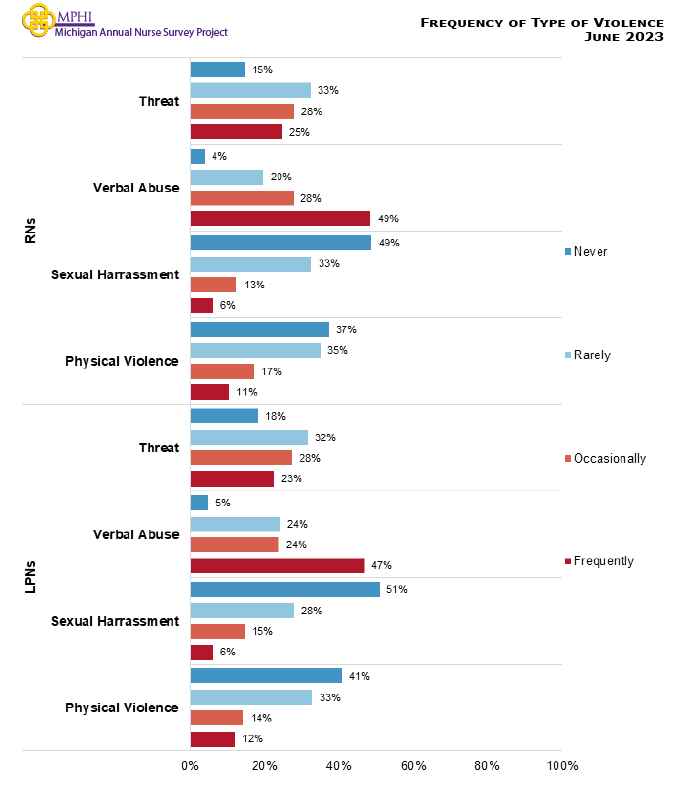
Type of Workplace Violence Nurses Experienced by Age
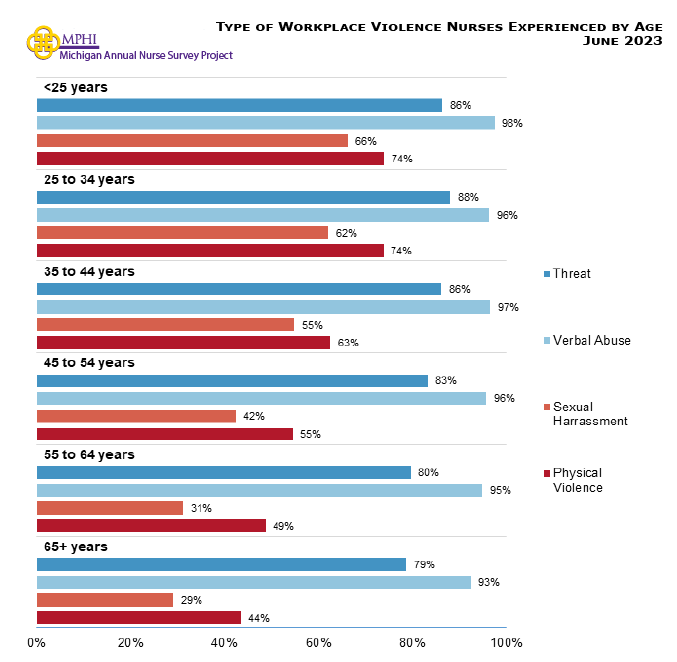
Perpetrator of Workplace Violence
| Perpetrator of WPV | RN = 5,067 | LPN = 324 | ||
|---|---|---|---|---|
| Estimate | 95% CI | Estimate | 95% CI | |
| Patient | 82.9% | (81.8%, 83.9%) | 79.1% | (74.3%, 83.2%) |
| Family or Friend of Patient | 22.5% | (21.4%, 23.7%) | 15.8% | (12.2%, 20.2%) |
| Supervisor | 5.2% | (4.6%, 5.8%) | 11.1% | (8.1%, 15.0%) |
| Physician | 7.1% | (6.4%, 7.8%) | 3.5% | (2.0%, 6.1%) |
| Peer | 8.8% | (8.1%, 9.6%) | 17.2% | (13.5%, 21.7%) |
| Other | 1.8% | (1.5%, 2.2%) | * | * |
a Respondents were instructed to mark all that apply, but this feature was not working for this response option.
b In previous years, respondents note about issues with survey programming in which it only allowed them to pick one response option
* Data are suppressed if count is less than 10 or sample population was less than 20.
Perpetrator & Type of Violence
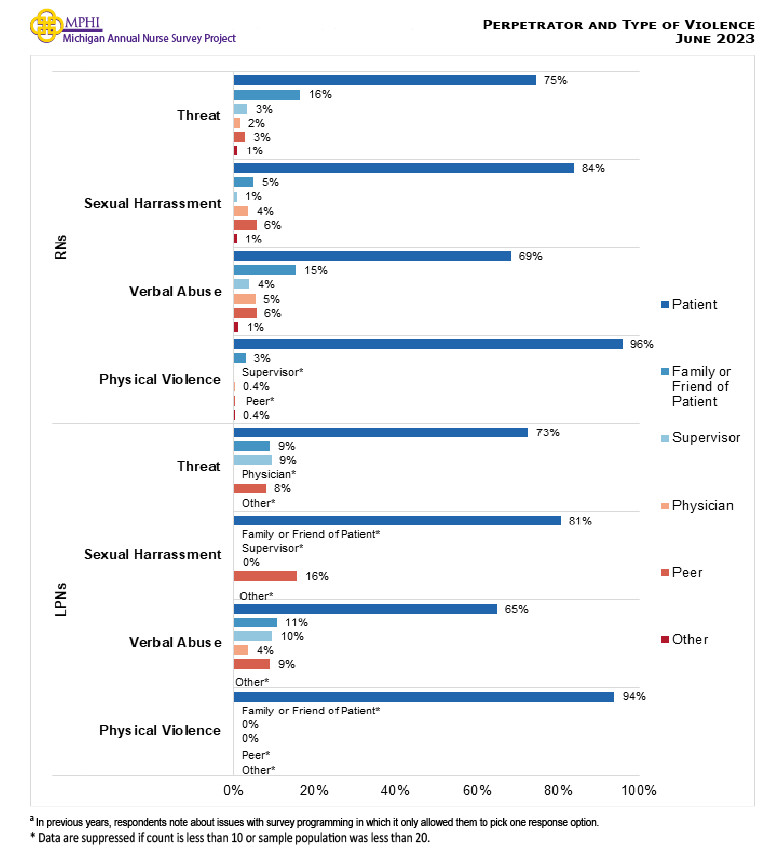
a In previous years, respondents note about issues with survey programming in which it only allowed them to pick one response option.
* Data are suppressed if count is less than 10 or sample population was less than 20.
Reporting of Workplace Violence
Reporting of Workplace Violence Incidence
| Reporting of Workplace Violence | RN = 5,088 | LPN = 326 | ||
|---|---|---|---|---|
| Estimate | 95% CI | Estimate | 95% CI | |
| Knowledge of Organizational Process for Reporting Workplace Violence | ||||
| Yes | 82.0% | (80.9%, 83.0%) | 76.3% | (71.4%, 80.6%) |
| No | 5.1% | (4.5%, 5.7%) | 14.2% | (10.8%, 18.4%) |
| Don’t Know | 13.0% | (12.1%, 14.0%) | 9.5% | (6.8%, 13.2%) |
| Reported Workplace Violence Using Organizational Process | ||||
| Yes | 59.2% | (57.7%, 60.7%) | 72.6% | (66.8%, 77.8%) |
Knowledge of Reporting Process of Workplace Violence Incidence
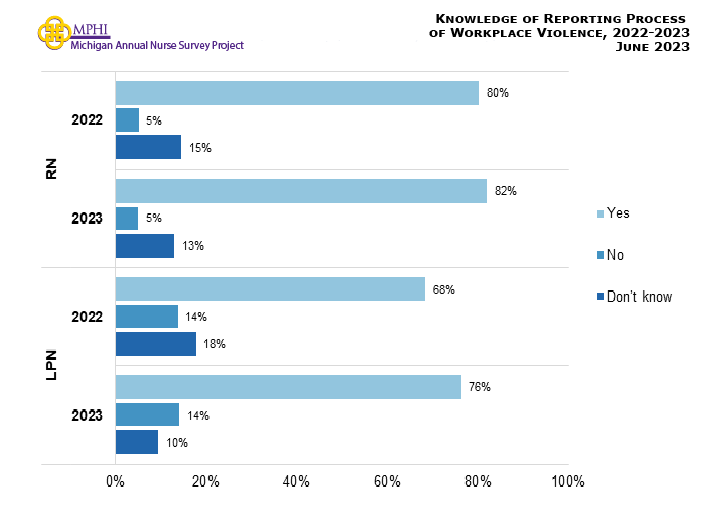
Knowledge of Organizational Reporting Process & Use of Reporting by Age
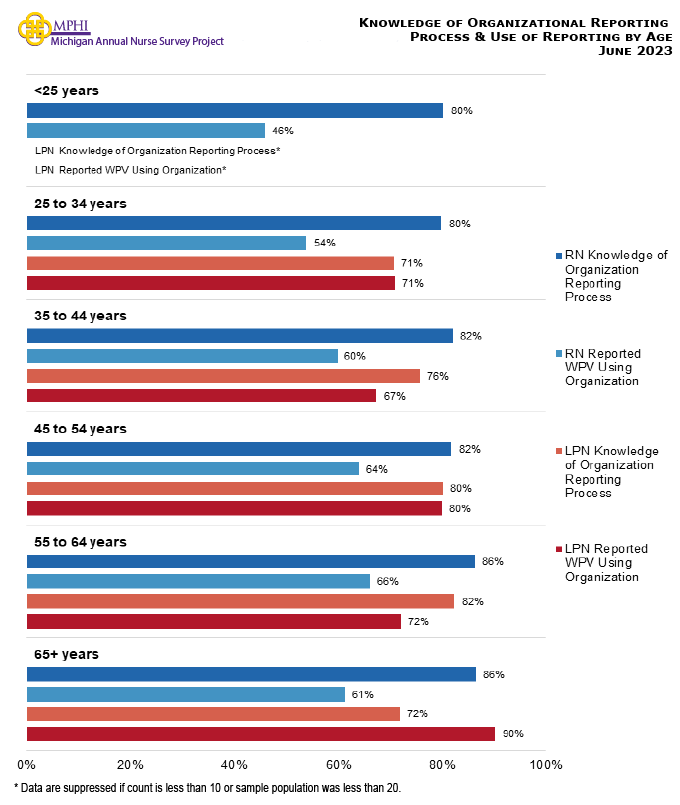
* Data are suppressed if count is less than 10 or sample population was less than 20.
Methods of Reporting Workplace Violence
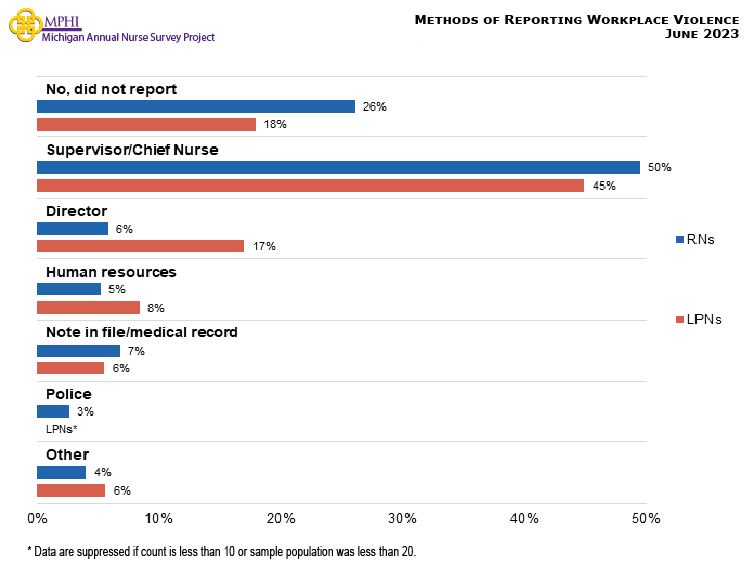
* Data are suppressed if count is less than 10 or sample population was less than 20.
Appendices Tables
Select Questions by Prosperity Region
Current Employment Status for RNs by Region
| Employment Status | Upper Peninsula | Northwest LP | Northeast LP | West/West Central | East Central | East | South Central | Southwest | Southeast | Detroit Metro |
|---|---|---|---|---|---|---|---|---|---|---|
| N | N | N | N | N | N | N | N | N | N | |
| Estimate | Estimate | Estimate | Estimate | Estimate | Estimate | Estimate | Estimate | Estimate | Estimate | |
| 95% CI | 95% CI | 95% CI | 95% CI | 95% CI | 95% CI | 95% CI | 95% CI | 95% CI | 95% CI | |
| Actively employed in nursing or in a position that requires a nurse license full-time | 211 | 322 | 151 | 1,435 | 470 | 690 | 358 | 583 | 886 | 2,799 |
| 63.1% | 58.4% | 65.5% | 61.8% | 70.4% | 68.7% | 65.6% | 64.6% | 62.4% | 63.8% | |
| (57.9%, 68.0%) | (54.4%, 62.3%) | (59.3%, 71.2%) | (59.8%, 63.7%) | (66.9%, 73.7%) | (65.8%, 71.4%) | (61.6%, 69.4%) | (61.5%, 67.6%) | (59.9%, 64.8%) | (62.4%, 65.2%) | |
| Actively employed in nursing or a position that requires a nurse license part-time | 44 | 64 | 17 | 433 | 54 | 113 | 66 | 96 | 186 | 559 |
| 13.4% | 10.4% | 6.6% | 18.4% | 8.1% | 10.5% | 11.0% | 10.7% | 12.5% | 12.4% | |
| (10.2%, 17.4%) | (8.2%, 13.1%) | (4.1%, 10.4%) | (16.9%, 20.0%) | (6.3%, 10.4%) | (8.8%, 12.5%) | (8.7%, 13.8%) | (8.9%, 12.9%) | (10.9%, 14.3%) | (11.5%, 13.4%) | |
| Actively employed in nursing or in a position that requires a nurse license on a per-diem basis | * | 33 | 12 | 100 | 28 | 45 | 39 | 38 | 64 | 267 |
| * | 5.6% | 4.8% | 4.2% | 3.8% | 4.2% | 6.5% | 4.1% | 4.4% | 6.0% | |
| * | (4.0%, 7.8%) | (2.7%, 8.3%) | (3.5%, 5.1%) | (2.6%, 5.5%) | (3.1%, 5.6%) | (4.8%, 8.8%) | (3.0%, 5.6%) | (3.5%, 5.6%) | (5.3%, 6.7%) | |
| On temporary medical leave from a position that requires a nurse license | * | * | 0 | 14 | * | * | * | * | 14 | 37 |
| * | * | 0.0% | 0.6% | * | * | * | * | 0.9% | 0.9% | |
| * | * | (0.0%, 1.6%) | (0.4%, 1.0%) | * | * | * | * | (0.5%, 1.5%) | (0.7%, 1.2%) | |
| On temporary non- medical leave from a position that requires a nurse license | 0 | * | 0 | * | * | * | * | * | * | * |
| 0.0% | * | 0.0% | * | * | * | * | * | * | * | |
| (0.0%, 1.1%) | * | (0.0%, 1.6%) | * | * | * | * | * | * | * | |
| Actively employed in a field other than nursing | 17 | 23 | * | 63 | * | 23 | 13 | 32 | 57 | 96 |
| 4.7% | 4.1% | * | 2.5% | * | 2.2% | 2.3% | 3.2% | 3.9% | 2.1% | |
| (2.9%, 7.5%) | (2.8%, 6.0%) | * | (1.9%, 3.2%) | * | (1.5%, 3.3%) | (1.4%, 3.9%) | (2.2%, 4.5%) | (3.0%, 5.0%) | (1.7%, 2.6%) | |
| Volunteer nurse status only | * | * | * | 24 | * | * | * | 13 | 13 | 51 |
| * | * | * | 0.9% | * | * | * | 1.3% | 0.8% | 1.0% | |
| * | * | * | (0.6%, 1.4%) | * | * | * | (0.7%, 2.3%) | (0.5%, 1.4%) | (0.7%, 1.3%) | |
| Unemployed, seeking work as a nurse | * | 14 | * | 29 | 12 | 14 | * | 21 | 22 | 86 |
| * | 2.0% | * | 1.2% | 1.8% | 1.2% | * | 2.2% | 1.5% | 1.8% | |
| * | (1.1%, 3.5%) | * | (0.8%, 1.7%) | (1.0%, 3.1%) | (0.7%, 2.1%) | * | (1.4%, 3.4%) | (1.0%, 2.3%) | (1.5%, 2.2%) | |
| Unemployed, not seeking work as a nurse | 11 | 14 | * | 62 | 10 | 19 | 18 | 27 | 40 | 104 |
| 3.4% | 2.5% | * | 2.7% | 1.5% | 2.0% | 3.4% | 2.9% | 2.8% | 2.4% | |
| (1.9%, 5.9%) | (1.5%, 4.1%) | * | (2.1%, 3.4%) | (0.8%, 2.7%) | (1.3%, 3.0%) | (2.2%, 5.2%) | (2.0%, 4.2%) | (2.1%, 3.8%) | (2.0%, 2.9%) | |
| Retired | 43 | 101 | 37 | 222 | 93 | 127 | 68 | 109 | 187 | 522 |
| 10.0% | 14.7% | 13.1% | 7.4% | 11.0% | 9.7% | 9.6% | 9.8% | 10.4% | 9.4% | |
| (7.3%, 13.6%) | (12.1%, 17.8%) | (9.4%, 17.9%) | (6.4%, 8.5%) | 8.9%, 13.6%) | (8.1%, 11.6%) | (7.4%, 12.3%) | (8.0%, 11.9%) | (8.9%, 12.1%) | (8.6%, 10.3%) |
* Data are suppressed if count is less than 10 or sample population was less than 20.
| Employment Status | Upper Peninsula | Northwest LP | Northeast LP | West/West Central | East Central | East | South Central | Southwest | Southeast | Detroit Metro |
|---|---|---|---|---|---|---|---|---|---|---|
| N | N | N | N | N | N | N | N | N | N | |
| Estimate | Estimate | Estimate | Estimate | Estimate | Estimate | Estimate | Estimate | Estimate | Estimate | |
| 95% CI | 95% CI | 95% CI | 95% CI | 95% CI | 95% CI | 95% CI | 95% CI | 95% CI | 95% CI | |
| Actively employed in nursing or in a position that requires a nurse license full-time | 497 | 652 | 272 | 2,556 | 889 | 1,389 | 726 | 1,184 | 1,860 | 5,675 |
| 65.0% | 61.1% | 60.1% | 60.4% | 67.1% | 65.9% | 65.0% | 65.8% | 62.1% | 63.2% | |
| (61.7%, 68.2%) | (58.3%, 63.8%) | (55.8%, 64.2%) | (59.0%, 61.8%) | (64.6%, 69.5%) | (63.9%, 67.8%) | (62.3%, 67.6%) | (63.7%, 67.9%) | (60.4%, 63.7%) | (62.2%, 64.2%) | |
| Actively employed in nursing or a position that requires a nurse license part-time | 75 | 117 | 29 | 756 | 108 | 216 | 107 | 208 | 385 | 1,030 |
| 9.3% | 9.4% | 5.3% | 16.5% | 7.7% | 9.6% | 9.0% | 10.8% | 11.7% | 10.6% | |
| (7.5%, 11.5%) | (7.9%, 11.2%) | (3.7%, 7.6%) | (15.5%, 17.6%) | (6.4%, 9.2%) | (8.5%, 10.9%) | (7.5%, 10.7%) | (9.5%, 12.3%) | (10.6%, 12.8%) | (10.0%, 11.2%) | |
| Actively employed in nursing or in a position that requires a nurse license on a per-diem basis | 27 | 68 | 25 | 180 | 70 | 109 | 76 | 95 | 161 | 606 |
| 2.9% | 5.0% | 4.7% | 3.7% | 4.9% | 4.8% | 6.0% | 4.5% | 5.0% | 6.2% | |
| (2.0%, 4.3%) | (3.9%, 6.4%) | (3.2%, 6.9%) | (3.2%, 4.3%) | (3.9%, 6.1%) | (4.0%, 5.8%) | (4.8%, 7.5%) | (3.7%, 5.5%) | (4.3%, 5.8%) | (5.7%, 6.7%) | |
| On temporary medical leave from a position that requires a nurse license | * | * | * | 33 | 16 | 27 | * | 17 | 26 | 124 |
| * | * | * | 0.7% | 1.0% | 1.2% | * | 0.9% | 0.8% | 1.3% | |
| * | * | * | (0.5%, 1.0%) | (0.6%, 1.7%) | (0.8%, 1.7%) | * | (0.6%, 1.4%) | (0.5%, 1.2%) | (1.1%, 1.5%) | |
| On temporary non- medical leave from a position that requires a nurse license | * | * | 0 | 14 | * | 10 | * | * | * | 42 |
| * | * | 0.0% | 0.2% | * | 0.4% | * | * | * | 0.4% | |
| * | * | (0.0%, 0.7%) | (0.1%, 0.4%) | * | (0.2%, 0.8%) | * | * | * | (0.3%, 0.5%) | |
| Actively employed in a field other than nursing | 28 | 44 | 11 | 136 | 31 | 58 | 41 | 47 | 112 | 231 |
| 3.6% | 3.5% | 2.0% | 2.8% | 2.1% | 2.5% | 3.1% | 2.4% | 3.4% | 2.2% | |
| (2.5%, 5.1%) | (2.6%, 4.7%) | (1.1%, 3.6%) | (2.4%, 3.3%) | (1.5%, 3.0%) | (1.9%, 3.2%) | (2.3%, 4.2%) | (1.8%, 3.2%) | (2.8%, 4.1%) | (1.9%, 2.5%) | |
| Volunteer nurse status only | 12 | 28 | 10 | 68 | 10 | 25 | 12 | 37 | 55 | 114 |
| 1.2% | 1.8% | 1.8% | 1.1% | 0.5% | 0.8% | 0.9% | 1.6% | 1.4% | 1.0% | |
| (0.7%, 2.2%) | (1.2%, 2.7%) | (1.0%, 3.4%) | (0.8%, 1.4%) | (0.2%, 1.0%) | (0.5%, 1.3%) | (0.5%, 1.6%) | (1.1%, 2.3%) | (1.1%, 1.9%) | (0.8%, 1.2%) | |
| Unemployed, seeking work as a nurse | 13 | 23 | 14 | 78 | 26 | 41 | 16 | 36 | 69 | 228 |
| 1.6% | 1.6% | 2.3% | 1.6% | 1.6% | 1.7% | 1.4% | 1.7% | 2.2% | 2.4% | |
| (0.9%, 2.7%) | (1.0%, 2.5%) | (1.3%, 4.0%) | (1.3%, 2.0%) | (1.1%, 2.4%) | (1.2%, 2.3%) | (0.9%, 2.2%) | (1.2%, 2.4%) | (1.8%, 2.8%) | (2.1%, 2.7%) | |
| Unemployed, not seeking work as a nurse | 27 | 42 | 17 | 174 | 39 | 45 | 37 | 56 | 87 | 270 |
| 3.5% | 3.5% | 3.7% | 4.0% | 2.4% | 2.0% | 3.2% | 2.8% | 2.8% | 2.9% | |
| (2.4%, 5.0%) | (2.6%, 4.7%) | (2.4%, 5.7%) | (3.5%, 4.6%) | (1.7%, 3.3%) | (1.5%, 2.7%) | (2.3%, 4.3%) | (2.2%, 3.6%) | (2.3%, 3.4%) | (2.6%, 3.3%) | |
| Retired | 145 | 226 | 134 | 634 | 258 | 370 | 181 | 268 | 509 | 1,390 |
| 12.1% | 13.0% | 19.8% | 9.0% | 12.4% | 11.0% | 10.3% | 9.4% | 10.4% | 9.7% | |
| (10.1%, 14.5%) | (11.2%, 15.0%) | (16.6%, 23.5%) | (8.2%, 9.9%) | (10.8%, 14.2%) | (9.8%, 12.3%) | (8.7%, 12.1%) | (8.2%, 10.8%) | (9.4%, 11.5%) | (9.1%, 10.3%) |
* Data are suppressed if count is less than 10 or sample population was less than 20.
| Employment Status | Upper Peninsula | Northwest LP | Northeast LP | West/West Central | East Central | East | South Central | Southwest | Southeast | Detroit Metro |
|---|---|---|---|---|---|---|---|---|---|---|
| N | N | N | N | N | N | N | N | N | N | |
| Estimate | Estimate | Estimate | Estimate | Estimate | Estimate | Estimate | Estimate | Estimate | Estimate | |
| 95% CI | 95% CI | 95% CI | 95% CI | 95% CI | 95% CI | 95% CI | 95% CI | 95% CI | 95% CI | |
| Actively employed in nursing or in a position that requires a nurse license full-time | 639 | 432 | 209 | 1,395 | 618 | 838 | 449 | 617 | 1,077 | 2,858 |
| 66.4% | 65.8% | 64.3% | 62.0% | 72.2% | 67.7% | 65.3% | 60.6% | 64.0% | 61.1% | |
| (62.6%, 70.0%) | (62.5%, 68.9%) | (59.6%, 68.7%) | (60.2%, 63.8%) | (69.3%, 74.9%) | (65.3%, 70.1%) | (62.0%, 68.5%) | (57.8%, 63.3%) | (61.9%, 66.1%) | (59.8%, 62.4%) | |
| Actively employed in nursing or a position that requires a nurse license part-time | 353 | 66 | 28 | 395 | 60 | 100 | 86 | 155 | 222 | 650 |
| 9.9% | 7.4% | 5.9% | 14.7% | 6.2% | 7.2% | 10.8% | 13.2% | 11.9% | 11.6% | |
| (7.8%, 12.5%) | (5.8%, 9.4%) | (4.0%, 8.6%) | (13.4%, 16.1%) | (4.9%, 7.9%) | (6.0%, 8.6%) | (8.9%, 13.1%) | (11.4%, 15.2%) | (10.6%, 13.4%) | (10.8%, 12.5%) | |
| Actively employed in nursing or in a position that requires a nurse license on a per-diem basis | 72 | 51 | 36 | 125 | 46 | 99 | 61 | 65 | 81 | 402 |
| 3.9% | 5.1% | 6.5% | 3.8% | 4.0% | 6.5% | 6.3% | 4.6% | 3.7% | 7.3% | |
| (2.7%, 5.7%) | (3.8%, 6.8%) | (4.5%, 9.3%) | (3.1%, 4.6%) | (3.0%, 5.4%) | (5.3%, 7.9%) | (4.8%, 8.2%) | (3.6%, 5.9%) | (3.0%, 4.6%) | (6.6%, 8.0%) | |
| On temporary medical leave from a position that requires a nurse license | * | * | * | 19 | 10 | 14 | * | 14 | 17 | 58 |
| * | * | * | 0.7% | 1.2% | 1.1% | * | 1.4% | 1.0% | 1.1% | |
| * | * | * | (0.4%, 1.1%) | (0.7%, 2.1%) | (0.7%, 1.8%) | * | (0.9%, 2.2%) | (0.6%, 1.5%) | (0.9%, 1.4%) | |
| On temporary non- medical leave from a position that requires a nurse license | 0 | * | * | * | * | * | 0 | * | * | 19 |
| 0.0% | * | * | * | * | * | 0.0% | * | * | 0.4% | |
| (0.0%, 0.6%) | * | * | * | * | * | (0.0%, 0.5%) | * | * | (0.3%, 0.6%) | |
| Actively employed in a field other than nursing | 25 | 30 | 11 | 101 | 23 | 43 | 21 | 50 | 58 | 159 |
| 4.0% | 3.5% | 2.7% | 3.4% | 2.3% | 2.8% | 2.4% | 4.4% | 2.9% | 2.6% | |
| (2.7%, 5.8%) | (2.5%, 5.0%) | (1.5%, 4.7%) | (2.8%, 4.1%) | (1.5%, 3.4%) | (2.1%, 3.8%) | (1.6%, 3.7%) | (3.4%, 5.7%) | (2.2%, 3.7%) | (2.2%, 3.1%) | |
| Volunteer nurse status only | * | * | * | 19 | * | 14 | * | 11 | 17 | 39 |
| * | * | * | 0.3% | * | 0.4% | * | 0.5% | 0.4% | 0.4% | |
| * | * | * | (0.2%, 0.6%) | * | (0.2%, 0.9%) | * | (0.2%, 1.1%) | (0.2%, 0.8%) | (0.3%, 0.6%) | |
| Unemployed, seeking work as a nurse | * | * | * | 27 | 12 | 20 | * | 13 | 24 | 85 |
| * | * | * | 1.3% | 1.5% | 1.1% | * | 0.8% | 1.5% | 1.6% | |
| * | * | * | (0.9%, 1.8%) | (0.9%, 2.5%) | (0.7%, 1.8%) | * | (0.4%, 1.5%) | (1.1%, 2.1%) | (1.3%, 2.0%) | |
| Unemployed, not seeking work as a nurse | 16 | 25 | 10 | 112 | 14 | 32 | 28 | 31 | 54 | 160 |
| 2.3% | 2.8% | 2.0% | 4.4% | 1.2% | 2.3% | 3.5% | 2.9% | 3.0% | 3.3% | |
| (1.4%, 3.8%) | (1.9%, 4.2%) | (1.0%, 3.8%) | (3.7%, 5.2%) | (0.7%, 2.1%) | (1.6%, 3.2%) | (2.4%, 5.0%) | (2.1%, 4.0%) | (2.3%, 3.8%) | (2.9%, 3.8%) | |
| Permanent disability leave | * | 10 | * | 28 | 14 | 21 | * | 17 | 23 | 55 |
| * | 0.9% | * | 0.6% | 0.9% | 1.3% | * | 1.1% | 0.9% | 0.8% | |
| * | (0.4%, 1.8%) | * | (0.4%, 1.0%) | (0.5%, 1.7%) | (0.8%, 2.0%) | * | (0.6%, 1.9%) | (0.6%, 1.4%) | (0.6%, 1.1%) | |
| Retired | 120 | 200 | 106 | 518 | 198 | 270 | 161 | 247 | 421 | 1,103 |
| 9.4% | 12.6% | 13.1% | 8.6% | 9.9% | 9.2% | 9.7% | 10.4% | 10.4% | 9.8% | |
| (7.4%, 11.9%) | (10.5%, 15.0%) | (10.2%, 16.6%) | (7.6%, 9.7%) | (8.2%, 11.9%) | (7.8%, 10.8%) | (7.9%, 11.9%) | (8.8%, 12.2%) | (9.1%, 11.8%) | (9.0%, 10.6%) |
Plans to Stop Working as a Nurse in the Next Five Years by Prosperity Region
| Region | 2019 | 2021 | 2023 | ||||||
|---|---|---|---|---|---|---|---|---|---|
| RNs = 20,890 | RNs = 22,966 | RNs = 12,681 | |||||||
| N | % | 95% CI | N | % | 95% CI | N | % | 95% CI | |
| Upper Peninsula | 250 | 25.0% | (20.0%, 30.7%) | 560 | 17.6% | (14.7%, 21.0%) | 418 | 25.7% | (21.7%, 30.1%) |
| Northwest LP | 402 | 23.3% | (19.4%, 27.7%) | 763 | 24.3% | (21.4%, 27.5%) | 495 | 27.4% | (23.7%, 31.5%) |
| Northeast LP | 167 | 17.6% | (12.5%, 24.0%) | 295 | 19.5% | (15.4%, 24.4%) | 232 | 25.5% | (20.3%, 31.5%) |
| West/West Central | 1,866 | 17.7% | (16.1%, 19.5%) | 3,153 | 17.3% | (16.0%, 18.7%) | 1,717 | 19.0% | (17.2%, 20.9%) |
| East Central | 522 | 15.1% | (12.2%, 18.4%) | 1,033 | 17.6% | (15.4%, 20.0%) | 709 | 20.3% | (17.5%, 23.4%) |
| East | 808 | 17.7% | (15.2%, 20.5%) | 1,306 | 16.8% | (14.9%, 18.9%) | 787 | 19.9% | (17.3%, 22.8%) |
| South Central | 437 | 19.9% | (16.4%, 23.9%) | 852 | 21.3% | (18.7%, 24.2%) | 579 | 24.5% | (21.2%, 28.2%) |
| Southwest | 678 | 20.3% | (17.4%, 23.5%) | 1,401 | 19.9% | (17.9%, 22.1%) | 812 | 22.4% | (19.7%, 25.4%) |
| Southeast | 1,082 | 20.1% | (17.8%, 22.6%) | 2,523 | 19.4% | (17.9%, 21.0%) | 1,548 | 23.3% | (21.3%, 25.5%) |
| Detroit Metro | 3,363 | 18.6% | (17.4%, 20.0%) | 6,352 | 20.9% | (19.9%, 21.9%) | 3,576 | 25.8% | (24.4%, 27.3%) |
| Lives in Michigan | 10,065 | 19.0% | (18.3%, 19.8%) | 2,079 | 20.6% | (18.9%, 22.4%) | 214 | 32.0% | (26.1%, 38.5%) |
| Lives Outside of Michigan | 1,250 | 19.5% | (17.4%, 21.8%) | 2,649 | 20.1% | (18.6%, 21.7%) | 1,594 | 24.4% | (22.4%, 26.6%) |
| Region | 2019 | 2021 | 2023 | ||||||
| LPNs = 2,217 | LPNs = 2,498 | LPNs = 1,052 | |||||||
| N | % | 95% CI | N | % | 95% CI | N | % | 95% CI | |
| Upper Peninsula | 72 | 21.6% | (13.7%, 32.5%) | 138 | 26.8% | (20.1%, 34.7%) | 79 | 22.0% | (14.3%, 32.3%) |
| Northwest LP | 37 | 39.9% | (25.8%, 55.9%) | 67 | 35.7% | (25.3%, 47.7%) | 39 | 31.3% | (19.0%, 47.0%) |
| Northeast LP | 29 | 18.8% | (8.6%, 36.3%) | 54 | 20.8% | (12.1%, 33.4%) | 25 | 17.1% | (7.1%, 35.9%) |
| West/West Central | 237 | 24.7% | (19.6%, 30.5%) | 365 | 22.3% | (18.3%, 26.8%) | 164 | 26.0% | (19.9%, 33.2%) |
| East Central | 66 | 23.3% | (14.8%, 34.8%) | 131 | 24.4% | (17.8%, 32.4%) | 63 | 15.0% | (8.2%, 25.8%) |
| East | 103 | 20.0% | (13.4%, 28.8%) | 158 | 27.0% | (20.7%, 34.4%) | 81 | 19.0% | (11.9%, 28.9%) |
| South Central | 27 | 28.1% | (14.8%, 47.0%) | 72 | 14.7% | (8.3%, 24.7%) | 33 | 18.9% | (9.1%, 35.2%) |
| Southwest | 76 | 16.9% | (10.1%, 26.8%) | 139 | 18.9% | (13.3%, 26.2%) | 68 | 27.4% | (18.2%, 39.0%) |
| Southeast | 94 | 22.7% | (15.4%, 32.2%) | 226 | 18.2% | (13.7%, 23.7%) | 108 | 18.9% | (12.6%, 27.3%) |
| Detroit Metro | 318 | 18.7% | (14.8%, 23.3%) | 758 | 14.5% | (12.2%, 17.2%) | 307 | 19.3% | (15.3%, 24.1%) |
| Lives in Michigan | 1,101 | 21.6% | (19.3%, 24.1%) | 234 | 21.3% | (16.5%, 27.0%) | 19 | 75.2% | (52.8%, 89.2%) |
| Lives Outside of Michigan | 57 | 22.0% | (13.2%, 34.4%) | 156 | 16.3% | (11.3%, 22.9%) | 66 | 23.2% | (14.7%, 34.7%) |
* Data are suppressed if count is less than 10 or sample population was less than 20.
Preparedness for Entering Nursing Workforce by Prosperity Region
| Region | 2019 | 2021 | 2023 | ||||||
|---|---|---|---|---|---|---|---|---|---|
| RNs | RNs | RNs | |||||||
| N | % | 95% CI | N | % | 95% CI | N | % | 95% CI | |
| Upper Peninsula | 28 | 43.6% | (27.1%, 61.6%) | 44 | 44.6% | (30.9%, 59.1%) | 19 | 35.6% | (18.2%, 57.8%) |
| Northwest LP | 35 | 51.3% | (35.5%, 66.9%) | 72 | 55.9% | (44.4%, 66.8%) | 29 | 59.6% | (41.7%, 75.3%) |
| Northeast LP | 12 | 50.7% | (25.9%, 75.2%) | 23 | 54.2% | (34.7%, 72.5%) | * | * | * |
| West/West Central | 195 | 49.2% | (42.3%, 56.2%) | 336 | 52.5% | (47.2%, 57.8%) | 134 | 43.7% | (35.6%, 52.2%) |
| East Central | 60 | 60.7% | (48.1%, 72.1%) | 75 | 45.5% | (34.7%, 56.7%) | 44 | 30.5% | (18.9%, 45.2%) |
| East | 75 | 51.4% | (40.3%, 62.4%) | 147 | 50.7% | (42.7%, 58.7%) | 64 | 31.9% | (21.8%, 44.1%) |
| South Central | 41 | 31.9% | (19.7%, 47.2%) | 70 | 46.8% | (35.6%, 58.3%) | 35 | 38.4% | (24.2%, 54.9%) |
| Southwest | 51 | 53.8% | (40.3%, 66.7%) | 120 | 45.7% | (37.1%, 54.6%) | 34 | 45.7% | (30.3%, 62.0%) |
| Southeast | 113 | 45.8% | (36.9%, 54.9%) | 206 | 49.7% | (42.9%, 56.5%) | 72 | 35.0% | (25.0%, 46.5%) |
| Detroit Metro | 390 | 52.6% | (47.6%, 57.5%) | 682 | 51.6% | (47.9%, 55.3%) | 221 | 41.2% | (34.9%, 47.8%) |
* Data are suppressed if count is less than 10 or sample population was less than 20.
Movement within the Nursing Workforce in Michigan
Movement of Nurses Among RNs Living in Michigan
| Aged 64 years or younger | ||||||||
|---|---|---|---|---|---|---|---|---|
| Living in MI in Baseline Year | Baseline Year | |||||||
| 2019 | 2020 | 2021 | 2022 | |||||
| # | % | # | % | # | % | # | % | |
| Nurses in Baseline Year | 116,531 | – | 119,903 | – | 117,955 | – | 115,448 | – |
| In Following Year: | 2020 | 2021 | 2022 | 2023 | ||||
| Same Region | 114,088 | 97.9 | 115,191 | 96.1 | 106,947 | 90.7 | 112,042 | 97.0 |
| Different Region | 1,036 | 0.9 | 1,494 | 1.2 | 4,520 | 3.8 | 1,365 | 1.2 |
| Outside Michigan | 554 | 0.5 | 632 | 0.5 | 3,628 | 3.1 | 559 | 0.5 |
| Not Found | 853 | 0.7 | 2,586 | 2.2 | 2,860 | 2.4 | 1,482 | 1.3 |
| Aged 34 years or younger | ||||||||
| Living in MI in Baseline Year | Baseline Year | |||||||
| 2019 | 2020 | 2021 | 2022 | |||||
| # | % | # | % | # | % | # | % | |
| Nurses in Baseline Year | 30,842 | – | 33,188 | – | 31,359 | – | 30,921 | – |
| In Following Year: | 2020 | 2021 | 2022 | 2023 | ||||
| Same Region | 29,917 | 97.0 | 31,810 | 95.8 | 27,563 | 87.9 | 29,731 | 96.2 |
| Different Region | 466 | 1.5 | 735 | 2.2 | 1,832 | 5.8 | 629 | 2.0 |
| Outside Michigan | 180 | 0.6 | 198 | 0.6 | 1,283 | 4.1 | 206 | 0.7 |
| Not Found | 279 | 0.9 | 445 | 1.3 | 681 | 2.2 | 355 | 1.1 |
| Aged 35 to 64 years | ||||||||
| Living in MI in Baseline Year | Baseline Year | |||||||
| 2019 | 2020 | 2021 | 2022 | |||||
| # | % | # | % | # | % | # | % | |
| Nurses in Baseline Year | 85,689 | – | 86,715 | – | 86,596 | – | 84,527 | – |
| In Following Year: | 2020 | 2021 | 2022 | 2023 | ||||
| Same Region | 84,171 | 98.2 | 83,381 | 96.2 | 79,384 | 91.7 | 82,311 | 97.4 |
| Different Region | 570 | 0.7 | 759 | 0.9 | 2,688 | 3.1 | 736 | 0.9 |
| Outside Michigan | 374 | 0.4 | 434 | 0.5 | 2,345 | 2.7 | 353 | 0.4 |
| Not Found | 574 | 0.7 | 2,141 | 2.5 | 2,179 | 2.5 | 1,127 | 1.3 |
Movement of Nurses Among RNs Living Outside Michigan
| Aged 64 years or younger | ||||||||
|---|---|---|---|---|---|---|---|---|
| Living in MI in Baseline Year | Baseline Year | |||||||
| 2019 | 2020 | 2021 | 2022 | |||||
| # | % | # | % | # | % | # | % | |
| Nurses in Baseline Year | 17,904 | – | 21,119 | – | 22,727 | – | 30,643 | – |
| In Following Year: | 2020 | 2021 | 2022 | 2023 | ||||
| Outside Michigan | 16,381 | 91.5 | 18,727 | 88.7 | 19,192 | 84.4 | 25,081 | 81.8 |
| Moved to Michigan | 424 | 2.4 | 434 | 2.1 | 963 | 4.2 | 2,927 | 9.6 |
| Unknown | 1,099 | 6.1 | 1,958 | 9.3 | 2,572 | 11.3 | 2,635 | 8.6 |
| Aged 34 years or younger | ||||||||
| Living in MI in Baseline Year | Baseline Year | |||||||
| 2019 | 2020 | 2021 | 2022 | |||||
| # | % | # | % | # | % | # | % | |
| Nurses in Baseline Year | 3,678 | – | 4,483 | – | 4,709 | – | 7,453 | – |
| In Following Year: | 2020 | 2021 | 2022 | 2023 | ||||
| Outside Michigan | 3,183 | 86.5 | 3,892 | 86.8 | 3,819 | 81.1 | 5,817 | 78.0 |
| Moved to Michigan | 184 | 5.0 | 181 | 4.0 | 419 | 8.9 | 1,044 | 14.0 |
| Unknown | 311 | 8.5 | 410 | 9.1 | 471 | 10.0 | 592 | 7.9 |
| Aged 35 to 64 years | ||||||||
| Living in MI in Baseline Year | Baseline Year | |||||||
| 2019 | 2020 | 2021 | 2022 | |||||
| # | % | # | % | # | % | # | % | |
| Nurses in Baseline Year | 14,226 | – | 16,636 | – | 18,018 | – | 23,190 | – |
| In Following Year: | 2020 | 2021 | 2022 | 2023 | ||||
| Outside Michigan | 13,198 | 92.8 | 14,835 | 89.2 | 15,373 | 85.3 | 19,264 | 83.1 |
| Moved to Michigan | 240 | 1.7 | 253 | 1.5 | 544 | 3.0 | 1,883 | 8.1 |
| Unknown | 788 | 5.5 | 1,548 | 9.3 | 2,101 | 11.7 | 2,043 | 8.8 |
Movement of Nurses Among RNs Living in the Upper Peninsula of Michigan
| Aged 64 years or younger | ||||||||
|---|---|---|---|---|---|---|---|---|
| Living in MI in Baseline Year | Baseline Year | |||||||
| 2019 | 2020 | 2021 | 2022 | |||||
| # | % | # | % | # | % | # | % | |
| Nurses in Baseline Year | 3,743 | – | 3,749 | – | 3,685 | – | 3,559 | – |
| In Following Year: | 2020 | 2021 | 2022 | 2023 | ||||
| Same Region | 3,570 | 95.4 | 3,579 | 95.5 | 3,326 | 90.3 | 3,430 | 96.4 |
| Different Region | 27 | 0.7 | 24 | 0.6 | 74 | 2.0 | 30 | 0.8 |
| Outside Michigan | 85 | 2.3 | 25 | 0.7 | 131 | 3.6 | 22 | 0.6 |
| Not Found | 61 | 1.6 | 121 | 3.2 | 154 | 4.2 | 77 | 2.2 |
| Aged 34 years or younger | ||||||||
| Living in MI in Baseline Year | Baseline Year | |||||||
| 2019 | 2020 | 2021 | 2022 | |||||
| # | % | # | % | # | % | # | % | |
| Nurses in Baseline Year | 955 | – | 1,008 | – | 948 | – | 922 | – |
| In Following Year: | 2020 | 2021 | 2022 | 2023 | ||||
| Same Region | 908 | 95.1 | 956 | 94.8 | 834 | 88.0 | 886 | 96.1 |
| Different Region | 10 | 1.0 | 17 | 1.7 | 31 | 3.3 | 11 | 1.2 |
| Outside Michigan | 22 | 2.3 | * | * | 46 | 4.9 | * | * |
| Not Found | 15 | 1.6 | 29 | 2.9 | 37 | 3.9 | 17 | 1.8 |
| Aged 35 to 64 years | ||||||||
| Living in MI in Baseline Year | Baseline Year | |||||||
| 2019 | 2020 | 2021 | 2022 | |||||
| # | % | # | % | # | % | # | % | |
| Nurses in Baseline Year | 2,788 | – | 2,741 | – | 2,737 | – | 2,637 | – |
| In Following Year: | 2020 | 2021 | 2022 | 2023 | ||||
| Same Region | 2,662 | 95.5 | 2,623 | 95.7 | 2,492 | 91.0 | 2,544 | 96.5 |
| Different Region | 17 | 0.6 | * | * | 43 | 1.6 | 19 | 0.7 |
| Outside Michigan | 63 | 2.3 | 19 | 0.7 | 85 | 3.1 | 14 | 0.5 |
| Not Found | 46 | 1.6 | 92 | 3.4 | 117 | 4.3 | 60 | 2.3 |
* Data are suppressed if count is less than 10 or sample population was less than 20.
Movement of Nurses Among RNs Living in the Northwest Lower Peninsula of Michigan
| Aged 64 years or younger | ||||||||
|---|---|---|---|---|---|---|---|---|
| Living in MI in Baseline Year | Baseline Year | |||||||
| 2019 | 2020 | 2021 | 2022 | |||||
| # | % | # | % | # | % | # | % | |
| Nurses in Baseline Year | 4,102 | – | 4,212 | – | 4,088 | – | 4,019 | – |
| In Following Year: | 2020 | 2021 | 2022 | 2023 | ||||
| Same Region | 4,012 | 97.8 | 4,019 | 95.4 | 3,690 | 90.3 | 3,901 | 97.1 |
| Different Region | 46 | 1.1 | 68 | 1.6 | 156 | 3.8 | 52 | 1.3 |
| Outside Michigan | 23 | 0.6 | 23 | 0.5 | 115 | 2.8 | 14 | 0.3 |
| Not Found | 21 | 0.5 | 102 | 2.4 | 127 | 3.1 | 52 | 1.3 |
| Aged 34 years or younger | ||||||||
| Living in MI in Baseline Year | Baseline Year | |||||||
| 2019 | 2020 | 2021 | 2022 | |||||
| # | % | # | % | # | % | # | % | |
| Nurses in Baseline Year | 909 | – | 980 | – | 880 | – | 883 | – |
| In Following Year: | 2020 | 2021 | 2022 | 2023 | ||||
| Same Region | 883 | 97.1 | 929 | 94.8 | 755 | 85.8 | 846 | 95.8 |
| Different Region | 15 | 1.7 | 32 | 3.3 | 66 | 7.5 | 23 | 2.6 |
| Outside Michigan | * | * | * | * | 33 | 3.8 | * | * |
| Not Found | * | * | 14 | 1.4 | 26 | 3.0 | * | * |
| Aged 35 to 64 years | ||||||||
| Living in MI in Baseline Year | Baseline Year | |||||||
| 2019 | 2020 | 2021 | 2022 | |||||
| # | % | # | % | # | % | # | % | |
| Nurses in Baseline Year | 3,193 | – | 3,232 | – | 3,208 | – | 3,136 | – |
| In Following Year: | 2020 | 2021 | 2022 | 2023 | ||||
| Same Region | 3,129 | 98.0 | 3,090 | 95.6 | 2,935 | 91.5 | 3,055 | 97.4 |
| Different Region | 31 | 1.0 | 36 | 1.1 | 90 | 2.8 | 29 | 0.9 |
| Outside Michigan | 16 | 0.5 | 18 | 0.6 | 82 | 2.6 | * | * |
| Not Found | 17 | 0.5 | 88 | 2.7 | 101 | 3.1 | 44 | 1.4 |
* Data are suppressed if count is less than 10 or sample population was less than 20.
Movement of Nurses Among RNs Living in the Northeast Lower Peninsula of Michigan
| Aged 64 years or younger | ||||||||
|---|---|---|---|---|---|---|---|---|
| Living in MI in Baseline Year | Baseline Year | |||||||
| 2019 | 2020 | 2021 | 2022 | |||||
| # | % | # | % | # | % | # | % | |
| Nurses in Baseline Year | 2,070 | – | 2,143 | – | 2,107 | – | 2,118 | – |
| In Following Year: | 2020 | 2021 | 2022 | 2023 | ||||
| Same Region | 2,027 | 97.9 | 2,032 | 94.8 | 1,839 | 87.3 | 2,027 | 95.7 |
| Different Region | 28 | 1.4 | 46 | 2.1 | 136 | 6.5 | 56 | 2.6 |
| Outside Michigan | * | * | 14 | 0.7 | 70 | 3.3 | * | * |
| Not Found | * | * | 51 | 2.4 | 62 | 2.9 | 27 | 1.3 |
| Aged 34 years or younger | ||||||||
| Living in MI in Baseline Year | Baseline Year | |||||||
| 2019 | 2020 | 2021 | 2022 | |||||
| # | % | # | % | # | % | # | % | |
| Nurses in Baseline Year | 452 | – | 488 | – | 479 | – | 475 | – |
| In Following Year: | 2020 | 2021 | 2022 | 2023 | ||||
| Same Region | 435 | 96.2 | 461 | 94.5 | 398 | 83.1 | 448 | 94.3 |
| Different Region | 11 | 2.4 | 20 | 4.1 | 55 | 11.5 | 21 | 4.4 |
| Outside Michigan | * | * | * | * | 19 | 4.0 | * | * |
| Not Found | * | * | * | * | * | * | * | * |
| Aged 35 to 64 years | ||||||||
| Living in MI in Baseline Year | Baseline Year | |||||||
| 2019 | 2020 | 2021 | 2022 | |||||
| # | % | # | % | # | % | # | % | |
| Nurses in Baseline Year | 1,618 | – | 1,655 | – | 1,628 | – | 1,643 | – |
| In Following Year: | 2020 | 2021 | 2022 | 2023 | ||||
| Same Region | 1,592 | 98.4 | 1,571 | 94.9 | 1,441 | 88.5 | 1,579 | 96.1 |
| Different Region | 17 | 1.1 | 26 | 1.6 | 81 | 5.0 | 35 | 2.1 |
| Outside Michigan | * | * | 13 | 0.8 | 51 | 3.1 | * | * |
| Not Found | * | * | 45 | 2.7 | 55 | 3.4 | 24 | 1.5 |
* Data are suppressed if count is less than 10 or sample population was less than 20.
Movement of Nurses Among RNs Living in West Michigan
| Aged 64 years or younger | ||||||||
|---|---|---|---|---|---|---|---|---|
| Living in MI in Baseline Year | Baseline Year | |||||||
| 2019 | 2020 | 2021 | 2022 | |||||
| # | % | # | % | # | % | # | % | |
| Nurses in Baseline Year | 17,712 | – | 18,261 | – | 17,997 | – | 17,738 | – |
| In Following Year: | 2020 | 2021 | 2022 | 2023 | ||||
| Same Region | 17,429 | 98.4 | 17,671 | 96.8 | 16,634 | 92.4 | 17,278 | 97.4 |
| Different Region | 114 | 0.6 | 155 | 0.8 | 419 | 2.3 | 152 | 0.9 |
| Outside Michigan | 67 | 0.4 | 89 | 0.5 | 567 | 3.2 | 68 | 0.4 |
| Not Found | 102 | 0.6 | 346 | 1.9 | 377 | 2.1 | 240 | 1.4 |
| Aged 34 years or younger | ||||||||
| Living in MI in Baseline Year | Baseline Year | |||||||
| 2019 | 2020 | 2021 | 2022 | |||||
| # | % | # | % | # | % | # | % | |
| Nurses in Baseline Year | 5,330 | – | 5,622 | – | 5,289 | – | 5,220 | – |
| In Following Year: | 2020 | 2021 | 2022 | 2023 | ||||
| Same Region | 5,185 | 97.3 | 5,442 | 96.8 | 4,754 | 89.9 | 5,042 | 96.6 |
| Different Region | 69 | 1.3 | 72 | 1.3 | 212 | 4.0 | 82 | 1.6 |
| Outside Michigan | 33 | 0.6 | 39 | 0.7 | 222 | 4.2 | 32 | 0.6 |
| Not Found | 43 | 0.8 | 69 | 1.2 | 101 | 1.9 | 64 | 1.2 |
| Aged 35 to 64 years | ||||||||
| Living in MI in Baseline Year | Baseline Year | |||||||
| 2019 | 2020 | 2021 | 2022 | |||||
| # | % | # | % | # | % | # | % | |
| Nurses in Baseline Year | 12,382 | – | 12,639 | – | 12,708 | – | 12,518 | – |
| In Following Year: | 2020 | 2021 | 2022 | 2023 | ||||
| Same Region | 12,244 | 98.9 | 12,229 | 96.8 | 11,880 | 93.5 | 12,236 | 97.7 |
| Different Region | 45 | 0.4 | 83 | 0.7 | 207 | 1.6 | 70 | 0.6 |
| Outside Michigan | 34 | 0.3 | 50 | 0.4 | 345 | 2.7 | 36 | 0.3 |
| Not Found | 59 | 0.5 | 277 | 2.2 | 276 | 2.2 | 176 | 1.4 |
Movement of Nurses Among RNs Living in East Central Michigan
| Aged 64 years or younger | ||||||||
|---|---|---|---|---|---|---|---|---|
| Living in MI in Baseline Year | Baseline Year | |||||||
| 2019 | 2020 | 2021 | 2022 | |||||
| # | % | # | % | # | % | # | % | |
| Nurses in Baseline Year | 6,855 | – | 7,063 | – | 7,010 | – | 6,896 | – |
| In Following Year: | 2020 | 2021 | 2022 | 2023 | ||||
| Same Region | 6,728 | 98.1 | 6,798 | 96.2 | 6,420 | 91.6 | 6,723 | 97.5 |
| Different Region | 71 | 1.0 | 89 | 1.3 | 273 | 3.9 | 86 | 1.2 |
| Outside Michigan | 21 | 0.3 | 35 | 0.5 | 180 | 2.6 | 21 | 0.3 |
| Not Found | 35 | 0.5 | 141 | 2.0 | 137 | 2.0 | 66 | 1.0 |
| Aged 34 years or younger | ||||||||
| Living in MI in Baseline Year | Baseline Year | |||||||
| 2019 | 2020 | 2021 | 2022 | |||||
| # | % | # | % | # | % | # | % | |
| Nurses in Baseline Year | 1,743 | – | 1,908 | – | 1,768 | – | 1,707 | – |
| In Following Year: | 2020 | 2021 | 2022 | 2023 | ||||
| Same Region | 1,743 | 97.1 | 1,832 | 96.0 | 1,566 | 88.6 | 1,641 | 96.1 |
| Different Region | 34 | 1.9 | 45 | 2.4 | 127 | 7.2 | 47 | 2.8 |
| Outside Michigan | * | * | 12 | 0.6 | 58 | 3.3 | * | * |
| Not Found | * | * | 19 | 1.0 | 17 | 1.0 | 12 | 0.7 |
| Aged 35 to 64 years | ||||||||
| Living in MI in Baseline Year | Baseline Year | |||||||
| 2019 | 2020 | 2021 | 2022 | |||||
| # | % | # | % | # | % | # | % | |
| Nurses in Baseline Year | 5,060 | – | 5,155 | – | 5,242 | – | 5,189 | – |
| In Following Year: | 2020 | 2021 | 2022 | 2023 | ||||
| Same Region | 4,985 | 98.5 | 4,966 | 96.3 | 4,854 | 92.6 | 5,082 | 97.9 |
| Different Region | 37 | 0.7 | 44 | 0.9 | 146 | 2.8 | 39 | 0.8 |
| Outside Michigan | 14 | 0.3 | 23 | 0.4 | 122 | 2.3 | 14 | 0.3 |
| Not Found | 24 | 0.5 | 122 | 2.4 | 120 | 2.3 | 54 | 1.0 |
* Data are suppressed if count is less than 10 or sample population was less than 20.
Movement of Nurses Among RNs Living in East Michigan
| Aged 64 years or younger | ||||||||
|---|---|---|---|---|---|---|---|---|
| Living in MI in Baseline Year | Baseline Year | |||||||
| 2019 | 2020 | 2021 | 2022 | |||||
| # | % | # | % | # | % | # | % | |
| Nurses in Baseline Year | 10,635 | – | 10,945 | – | 10,774 | – | 10,318 | – |
| In Following Year: | 2020 | 2021 | 2022 | 2023 | ||||
| Same Region | 10,396 | 97.8 | 10,469 | 95.7 | 9,451 | 87.7 | 10,017 | 97.1 |
| Different Region | 137 | 1.3 | 212 | 1.9 | 820 | 7.6 | 146 | 1.4 |
| Outside Michigan | 29 | 0.3 | 37 | 0.3 | 285 | 2.6 | 47 | 0.5 |
| Not Found | 73 | 0.7 | 227 | 2.1 | 218 | 2.0 | 108 | 1.0 |
| Aged 34 years or younger | ||||||||
| Living in MI in Baseline Year | Baseline Year | |||||||
| 2019 | 2020 | 2021 | 2022 | |||||
| # | % | # | % | # | % | # | % | |
| Nurses in Baseline Year | 2,569 | – | 2,797 | – | 2,656 | – | 2,646 | – |
| In Following Year: | 2020 | 2021 | 2022 | 2023 | ||||
| Same Region | 2,473 | 96.3 | 2,659 | 95.1 | 2,248 | 84.6 | 2,534 | 95.8 |
| Different Region | 63 | 2.5 | 106 | 3.8 | 292 | 11.0 | 70 | 2.6 |
| Outside Michigan | 10 | 0.4 | 14 | 0.5 | 68 | 2.6 | 23 | 0.9 |
| Not Found | 23 | 0.9 | 18 | 0.6 | 48 | 1.8 | 19 | 0.7 |
| Aged 35 to 64 years | ||||||||
| Living in MI in Baseline Year | Baseline Year | |||||||
| 2019 | 2020 | 2021 | 2022 | |||||
| # | % | # | % | # | % | # | % | |
| Nurses in Baseline Year | 8,066 | – | 8,148 | – | 8,118 | – | 7,672 | – |
| In Following Year: | 2020 | 2021 | 2022 | 2023 | ||||
| Same Region | 7,923 | 98.2 | 7,810 | 95.9 | 7,203 | 88.7 | 7,483 | 97.5 |
| Different Region | 74 | 0.9 | 106 | 1.3 | 528 | 6.5 | 76 | 1.0 |
| Outside Michigan | 19 | 0.2 | 23 | 0.3 | 217 | 2.7 | 24 | 0.3 |
| Not Found | 50 | 0.6 | 209 | 2.6 | 170 | 2.1 | 89 | 1.2 |
Movement of Nurses Among RNs Living in South Central Michigan
| Aged 64 years or younger | ||||||||
|---|---|---|---|---|---|---|---|---|
| Living in MI in Baseline Year | Baseline Year | |||||||
| 2019 | 2020 | 2021 | 2022 | |||||
| # | % | # | % | # | % | # | % | |
| Nurses in Baseline Year | 4,818 | – | 4,998 | – | 4,895 | – | 4,709 | – |
| In Following Year: | 2020 | 2021 | 2022 | 2023 | ||||
| Same Region | 4,693 | 97.4 | 4,758 | 95.2 | 4,255 | 86.9 | 4,531 | 96.2 |
| Different Region | 68 | 1.4 | 109 | 2.2 | 343 | 7.0 | 98 | 2.1 |
| Outside Michigan | 22 | 0.5 | 24 | 0.5 | 154 | 3.1 | 20 | 0.4 |
| Not Found | 35 | 0.7 | 107 | 2.1 | 143 | 2.9 | 60 | 1.3 |
| Aged 34 years or younger | ||||||||
| Living in MI in Baseline Year | Baseline Year | |||||||
| 2019 | 2020 | 2021 | 2022 | |||||
| # | % | # | % | # | % | # | % | |
| Nurses in Baseline Year | 1,237 | – | 1,343 | – | 1,225 | – | 1,167 | – |
| In Following Year: | 2020 | 2021 | 2022 | 2023 | ||||
| Same Region | 1,182 | 95.6 | 1,256 | 93.5 | 1,007 | 82.2 | 1,101 | 94.3 |
| Different Region | 35 | 2.8 | 59 | 4.4 | 136 | 11.1 | 49 | 4.2 |
| Outside Michigan | * | * | * | * | 52 | 4.2 | * | * |
| Not Found | 14 | 1.1 | 20 | 1.5 | 30 | 2.4 | 11 | 0.9 |
| Aged 35 to 64 years | ||||||||
| Living in MI in Baseline Year | Baseline Year | |||||||
| 2019 | 2020 | 2021 | 2022 | |||||
| # | % | # | % | # | % | # | % | |
| Nurses in Baseline Year | 3,581 | – | 3,655 | – | 3,670 | – | 3,542 | – |
| In Following Year: | 2020 | 2021 | 2022 | 2023 | ||||
| Same Region | 3,511 | 98.0 | 3,502 | 95.8 | 3,248 | 88.5 | 3,430 | 96.8 |
| Different Region | 33 | 0.9 | 50 | 1.4 | 207 | 5.6 | 49 | 1.4 |
| Outside Michigan | 16 | 0.4 | 16 | 0.4 | 102 | 2.8 | 14 | 0.4 |
| Not Found | 21 | 0.6 | 87 | 2.4 | 113 | 3.1 | 49 | 1.4 |
* Data are suppressed if count is less than 10 or sample population was less than 20.
Movement of Nurses Among RNs Living in Southwest Michigan
| Aged 64 years or younger | ||||||||
|---|---|---|---|---|---|---|---|---|
| Living in MI in Baseline Year | Baseline Year | |||||||
| 2019 | 2020 | 2021 | 2022 | |||||
| # | % | # | % | # | % | # | % | |
| Nurses in Baseline Year | 8,413 | – | 8,468 | – | 8,292 | – | 7,980 | – |
| In Following Year: | 2020 | 2021 | 2022 | 2023 | ||||
| Same Region | 8,096 | 96.2 | 8,081 | 95.4 | 7,447 | 89.8 | 7,708 | 96.6 |
| Different Region | 90 | 1.1 | 91 | 1.1 | 300 | 3.6 | 84 | 1.1 |
| Outside Michigan | 56 | 0.7 | 59 | 0.7 | 293 | 3.5 | 54 | 0.7 |
| Not Found | 171 | 2.0 | 237 | 2.8 | 252 | 3.0 | 134 | 1.7 |
| Aged 34 years or younger | ||||||||
| Living in MI in Baseline Year | Baseline Year | |||||||
| 2019 | 2020 | 2021 | 2022 | |||||
| # | % | # | % | # | % | # | % | |
| Nurses in Baseline Year | 1,906 | – | 1,994 | – | 1,872 | – | 1,772 | – |
| In Following Year: | 2020 | 2021 | 2022 | 2023 | ||||
| Same Region | 1,800 | 94.4 | 1,899 | 95.2 | 1,590 | 84.9 | 1,678 | 94.7 |
| Different Region | 37 | 1.9 | 43 | 2.2 | 128 | 6.8 | 43 | 2.4 |
| Outside Michigan | 18 | 0.9 | 16 | 0.8 | 106 | 5.7 | 22 | 1.2 |
| Not Found | 51 | 2.7 | 36 | 1.8 | 48 | 2.6 | 29 | 1.6 |
| Aged 35 to 64 years | ||||||||
| Living in MI in Baseline Year | Baseline Year | |||||||
| 2019 | 2020 | 2021 | 2022 | |||||
| # | % | # | % | # | % | # | % | |
| Nurses in Baseline Year | 6,507 | – | 6,474 | – | 6,420 | – | 6,208 | – |
| In Following Year: | 2020 | 2021 | 2022 | 2023 | ||||
| Same Region | 6,296 | 96.8 | 6,182 | 95.5 | 5,857 | 91.2 | 6,030 | 97.1 |
| Different Region | 53 | 0.8 | 48 | 0.7 | 172 | 2.7 | 41 | 0.7 |
| Outside Michigan | 38 | 0.6 | 43 | 0.7 | 187 | 2.9 | 32 | 0.5 |
| Not Found | 120 | 1.8 | 201 | 3.1 | 204 | 3.2 | 105 | 1.7 |
Movement of Nurses Among RNs Living in Southeast Michigan
| Aged 64 years or younger | ||||||||
|---|---|---|---|---|---|---|---|---|
| Living in MI in Baseline Year | Baseline Year | |||||||
| 2019 | 2020 | 2021 | 2022 | |||||
| # | % | # | % | # | % | # | % | |
| Nurses in Baseline Year | 13,498 | – | 13,921 | – | 13,717 | – | 14,234 | – |
| In Following Year: | 2020 | 2021 | 2022 | 2023 | ||||
| Same Region | 13,155 | 97.5 | 13,289 | 95.5 | 12,362 | 90.1 | 13,733 | 96.5 |
| Different Region | 168 | 1.2 | 225 | 1.6 | 502 | 3.7 | 212 | 1.5 |
| Outside Michigan | 72 | 0.5 | 96 | 0.7 | 439 | 3.2 | 75 | 0.5 |
| Not Found | 103 | 0.8 | 311 | 2.2 | 414 | 3.0 | 214 | 1.5 |
| Aged 34 years or younger | ||||||||
| Living in MI in Baseline Year | Baseline Year | |||||||
| 2019 | 2020 | 2021 | 2022 | |||||
| # | % | # | % | # | % | # | % | |
| Nurses in Baseline Year | 3,426 | – | 3,715 | – | 3,540 | – | 3,689 | – |
| In Following Year: | 2020 | 2021 | 2022 | 2023 | ||||
| Same Region | 3,288 | 96.0 | 3,499 | 94.2 | 3,029 | 85.6 | 3,491 | 94.6 |
| Different Region | 74 | 2.2 | 115 | 3.1 | 231 | 6.5 | 110 | 3.0 |
| Outside Michigan | 24 | 0.7 | 32 | 0.9 | 166 | 4.7 | 29 | 0.8 |
| Not Found | 40 | 1.2 | 69 | 1.9 | 114 | 3.2 | 59 | 1.6 |
| Aged 35 to 64 years | ||||||||
| Living in MI in Baseline Year | Baseline Year | |||||||
| 2019 | 2020 | 2021 | 2022 | |||||
| # | % | # | % | # | % | # | % | |
| Nurses in Baseline Year | 10,072 | – | 10,206 | – | 10,177 | – | 10,545 | – |
| In Following Year: | 2020 | 2021 | 2022 | 2023 | ||||
| Same Region | 9,867 | 98.0 | 9,790 | 95.9 | 9,333 | 91.7 | 10,242 | 97.1 |
| Different Region | 94 | 0.9 | 110 | 1.1 | 271 | 2.7 | 102 | 1.0 |
| Outside Michigan | 48 | 0.5 | 64 | 0.6 | 273 | 2.7 | 46 | 0.4 |
| Not Found | 63 | 0.6 | 242 | 2.4 | 300 | 2.9 | 155 | 1.5 |
Movement of Nurses Among RNs Living in the Detroit Metro Area of Michigan
| Aged 64 years or younger | ||||||||
|---|---|---|---|---|---|---|---|---|
| Living in MI in Baseline Year | Baseline Year | |||||||
| 2019 | 2020 | 2021 | 2022 | |||||
| # | % | # | % | # | % | # | % | |
| Nurses in Baseline Year | 44,685 | – | 46,143 | – | 45,390 | – | 43,877 | – |
| In Following Year: | 2020 | 2021 | 2022 | 2023 | ||||
| Same Region | 43,982 | 98.4 | 44,495 | 96.4 | 41,523 | 91.5 | 42,694 | 97.3 |
| Different Region | 287 | 0.6 | 475 | 1.0 | 1,497 | 3.3 | 449 | 1.0 |
| Outside Michigan | 171 | 0.4 | 230 | 0.5 | 1,394 | 3.1 | 230 | 0.5 |
| Not Found | 245 | 0.5 | 943 | 2.0 | 976 | 2.2 | 504 | 1.1 |
| Aged 34 years or younger | ||||||||
| Living in MI in Baseline Year | Baseline Year | |||||||
| 2019 | 2020 | 2021 | 2022 | |||||
| # | % | # | % | # | % | # | % | |
| Nurses in Baseline Year | 12,263 | – | 13,333 | – | 12,702 | – | 12,440 | – |
| In Following Year: | 2020 | 2021 | 2022 | 2023 | ||||
| Same Region | 12,020 | 98.0 | 12,877 | 96.6 | 11,382 | 89.6 | 12,064 | 97.0 |
| Different Region | 118 | 1.0 | 226 | 1.7 | 554 | 4.4 | 173 | 1.4 |
| Outside Michigan | 51 | 0.4 | 65 | 0.5 | 513 | 4.0 | 70 | 0.6 |
| Not Found | 74 | 0.6 | 165 | 1.2 | 253 | 2.0 | 133 | 1.1 |
| Aged 35 to 64 years | ||||||||
| Living in MI in Baseline Year | Baseline Year | |||||||
| 2019 | 2020 | 2021 | 2022 | |||||
| # | % | # | % | # | % | # | % | |
| Nurses in Baseline Year | 32,422 | – | 32,810 | – | 32,688 | – | 31,437 | – |
| In Following Year: | 2020 | 2021 | 2022 | 2023 | ||||
| Same Region | 31,962 | 98.6 | 31,618 | 96.4 | 30,141 | 92.2 | 30,630 | 97.4 |
| Different Region | 169 | 0.5 | 249 | 0.8 | 943 | 2.9 | 276 | 0.9 |
| Outside Michigan | 120 | 0.4 | 165 | 0.5 | 881 | 2.7 | 160 | 0.5 |
| Not Found | 171 | 0.5 | 778 | 2.4 | 723 | 2.2 | 371 | 1.2 |
2023 Survey Report
The 2023 Survey Report focuses on recent changes in the nursing workforce